Looking for the fastest accelerated computer science degrees online? You’re good with computers and you know it. So, why not make a lucrative career out of it?

Computers are everywhere: desktop, mobile, industrial, consumer… the possibilities are endless. Cisco puts the estimate at over 8 billion devices (and growing). It’s no wonder that an online computer science degree is so popular.
Editorial Listing ShortCode:
Universities Offering Online Computer Science Degrees
Methodology: The following school list is in alphabetical order. To be included, a college or university must be regionally accredited and offer computer science degree programs online or in a hybrid format.
1. Austin Peay State University
- BS in Computer Science
APSU is accredited by the Southern Association of Colleges and Schools Commission on Colleges.
2. Baker College
- BS in Computer Science – Computer Programming
Baker is accredited by the Higher Learning Commission.
3. California State University – Monterey Bay
- BS in Computer Science
CalState is accredited by the WASC Senior College and University Commission.
4. Charleston Southern University
- BT in Computer Science
Charleston Southern is accredited by the Commission on Colleges of the Southern Association of Colleges and Schools.
5. Colorado Technical University
- BS in Computer Science – General
Colorado Tech is accredited by the Higher Learning Commission.
6. Columbia College
- BS in Computer Science
Columbia is accredited by the Higher Learning Commission.
7. Concordia University
- BA in Computer Science
Concordia is accredited by the Southern Association of Colleges and Schools Commission on Colleges.
8. Dakota State University
- BS in Computer Science
Dakota State is accredited by the Higher Learning Commission.
9. Davenport University
- BS in Computer Science
Davenport is accredited by the Higher Learning Commission.
10. Depaul University
- BS in Computer Science
Depaul is accredited by the Higher Learning Commission.
11. Florida State University
- BA in Computer Science
- BS in Computer Science
Florida State is accredited by the Southern Association of Colleges and Schools, Commission on Colleges.
12. Fort Hays State University
- BS in Computer Science
FHSU is accredited by the Higher Learning Commission of the North Central Association of Colleges and Schools.
13. Franklin University
- BS in Computer Science
Franklin is accredited by the Higher Learning Commission.
14. Herzing University
- BS in Computer Programming
Herzing is accredited by the Higher Learning Commission.
15. Lamar University
- BS in Computer Science
Lamar is accredited by the Southern Association of Colleges and Schools Commission on Colleges.
16. Lewis University
- BA in Computer Science
Lewis is accredited by the Higher Learning Commission.
17. Limestone College
- BS in Computer Science
Limestone is accredited by the Commission on Colleges of the Southern Association of Colleges and Schools.
18. Mercy College
- BS in Computer Science
Mercy College is accredited by the Middle States Commission on Higher Education.
19. National University
- BS in Computer Science
NU is accredited by the WASC Senior College and University Commission.
20. Old Dominion University
- BS in Computer Science
ODU is accredited by the Southern Association of Colleges and Schools Commission on Colleges.
21. Oregon State University
- BS in Computer Science
Oregon State is accredited by the Northwest Commission on Colleges and Universities.
22. Pace University
- BS in Professional Technology Studies
Pace is accredited by the Middle States Commission on Higher Education.
23. Park University
- BS in Computer Science
Park is accredited by the Higher Learning Commission.
24. Regent University
- BS in Computer Science
Regent is accredited by the Southern Association of Colleges and Schools Commission on Colleges.
25. Regis University
- BS in Computer Science
Regis is accredited by the Higher Learning Commission.
26. Saint Leo University
- BS in Computer Science – Information Assurance
Saint Leo is accredited by the Southern Association of Colleges and Schools Commission on Colleges.
27. Salem University
- BS in Computer Science
Salem is accredited by the Higher Learning Commission.
28. Southeast Missouri State University
- BS in Computer Information Systems
SEMO is accredited by the Higher Learning Commission.
29. Southern New Hampshire University
- BS in Computer Science
SNHU is accredited by the New England Commission of Higher Education.
30. Trident University
- BS in Computer Science
Trident is accredited by the Western Association of Schools and Colleges Senior College and University Commission.
31. Troy University
- BS in Applied Computer Science
Troy is accredited by the Southern Association of Colleges and Schools Commission on Colleges.
32. University of Denver
- BA in Information Technology
DU is accredited by the Higher Learning Commission.
33. University of Florida
- BS in Computer Science
UF is accredited by the Southern Association of Colleges and Schools.
34. University of Illinois – Springfield
- BS in Computer Science
UIS is reaccredited by the Higher Learning Commission.
35. University of Maryland Global
- BS in Computer Science
UMUC is accredited by the Middle States Commission on Higher Education.
The computer science field pays well & is growing
Salary and job data provided by the U.S. Bureau of Labor Statistics.
- Median salary in IT field: $91,250
- Median salary for Software Developers: $110,140
- Computer & IT jobs will grow by 13% over the next ten years
Computer Science & IT Curriculum


Computer science is now considered a foundational science. It connects in with many other areas such as education, medicine, finance, communication, and entertainment.
You may excel in a computer science program if you enjoy solving problems, analyzing situations, can organize and think creatively and logically.
A sampling of common computer science courses:
- Introductory Programming
- Intermediate Programming
- Computer Systems and Architecture
- Building Secure Web Applications
- Data Structures and Analysis
- Advanced Programming Languages
- Object-Oriented and Concurrent Programming
- Compiler Theory and Design
- Design and Analysis of Computer Algorithms
- Operating Systems
- Computer Graphics
- Fundamentals of Mobile Web Application Development
- Emerging Trends in Technology
- Introduction to Business Intelligence
- Fundamentals of Cloud Computing
- Ethical Hacking
- Apple iOS Programming
- Universal Windows Applications Programming
- Visual Communication in the Media
- Fundamentals of Enterprise Architecture
Classes and courses like these can help prepare students to enter a rapidly changing career.
Instead of watching as computer science and software engineering evolves, you might be at the front of the change!
Computer Science Careers and Salaries

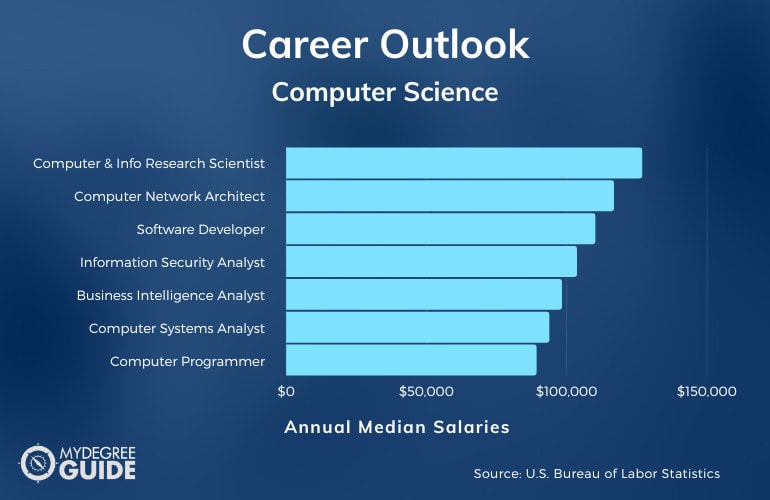
Forbes ranks computer science as one of the high earning undergraduate majors in the STEM fields.
The Bureau of Labor Statistics estimates that there will be 531,200 new jobs added in the computer and technology fields in the next decade… growing at a rate of 13%.
Computer related jobs are forecast to continue to grow and along with that growth comes a high demand for trained professionals.
According to the Bureau of Labor Statistics, some careers in the computer science field include:
| Careers | Annual Median Salary |
| Computer and Information Research Scientist | $126,830 |
| Computer Network Architect | $116,780 |
| Software Developer | $110,140 |
| Information Security Analyst | $103,590 |
| Business Intelligence Analyst | $98,230 |
| Computer Systems Analyst | $93,730 |
| Computer Programmer | $89,190 |
| Computer Systems Engineer | $87,190 |
| Network Systems Administrator | $84,810 |
The number of jobs in computer science is forecast to continue to rise. And with a masters in computer science online no GRE, you may even qualify for a higher paying position.
Accelerated Online Computer Science Classes


When you attend a college class at your local school, you will typically be sitting in class for 16 weeks. But it doesn’t have to take that long.
With computer science accelerated classes, you may finish your course in 6 weeks or 8 weeks online.
If you are ready to jump in and start now, then there is good news for you. You can! Most universities have new online accelerated class start dates every month.
Computer Science Careers in High-Demand


Computer science, sometimes abbreviated to CS or CompSci, is a trans-disciplinary course of study about the operation, architecture, use and design of computers, their hardware and software, as well as the mathematical elements such as those in the theories of computation such as algorithmic construction and analysis.
The candidate’s qualities or skills needed for such occupation are:
- Analytical skills
- Detail oriented personality
- Communication skills
- Logical thinking skills
- Critical thinking skills
- Concentration
- Ingenuity
What is a Bachelor of Computer Science?


A bachelor’s of computer science (BSC or BSCS) is a four year course of study at a degree-granting institution, though that timeframe may be shortened by taking a more intensive course of study leading to an accelerated computer science degree.
In a growing and evolving computing world where major money buys emergent technologies, who knows what the next WhatsApp will be. A BSC or MSC in Computer Science can help launch your career in this lucrative field of study.
Possible Career Paths for Computer Science Graduates
(Recent average salaries and projected growth through 2029 according to the Bureau of Labor Statistics)
- Information Security Analysts: $103,590 average pay per year, projected growth of 31 percent.
- Database Administrator: $98,860 average pay per year, projected growth of 10 percent.
- Computer Systems Analyst: $93,730 average pay per year, projected growth of 7 percent.
- Network Systems Administrator: $84,810 average pay per year, projected growth of 4 percent.
- Computer Network Architect: $116,780 average pay per year, projected growth of 5 percent.
- Web Developer: $77,200 average pay per year, projected growth of 8 percent.
- Software Developer: $110,140 average pay per year, projected growth of 22 percent.
- Computer Hardware Engineer: $119,560 average pay per year, projected growth of 2 percent.
- Computer and Information System Managers: $151,150 average pay per year, projected growth of 10 percent.
In fact, the Bureau of Labor Statistics notes the relatively low unemployment rates for computer and mathematical occupations as a whole and maps the areas all across America where such professionals are in high demand.
No matter where you want to go with your accelerated computer science degree, there are opportunities practically everywhere — not just Silicon Valley or Redmond, but everywhere in the US where business, industry, finance or government runs on computers.
Why a College Degree Matters


A degree may make a serious difference, especially in a field like computer science, where a bachelor’s or even a master’s degree is less as a certification and more of a basic qualification for job candidates seeking to work in the field.
As the occupation and technology evolves at a lightning fast pace, a bachelor’s degree from an accredited degree granting institution can be advantageous for a well-rounded and technologically current employee.
As previously mentioned, of the many reasons to obtain a degree, the most prominent are employability, financial security, and the long term benefits over the course of a working lifetime.
Salary & Education Level


The Bureau of Labor Statistics, in a recent study, averaged the salaries in unemployment percentages of people 25 and older, across all levels of education from no high school diploma all the way up the ladder to advanced degrees — master’s, Ph.D., and holders of professional degrees such as medical doctors and lawyers.
By the measures of annual wages and rates of unemployment, the difference even an associate degree makes in job and financial security is stark. The numbers, even when averaged, simply do not lie.
- Less than a high school diploma: $27,510 average annual earnings, with unemployment of 3.3 percent.
- High school diploma: $39,070 average annual earnings, with unemployment of 1.5 percent.
- Associate degree program: $56,590 average annual earnings, with unemployment of 6.2 percent.
- Bachelor’s degree program: $77,920 average annual earnings, with unemployment of 6.4 percent.
- Advanced degree (Ph.D and professional degrees): $110,200 average annual earnings, with unemployment of 5.9 percent.
When totaled over the course of 10 years, not accounting for raises, promotions with commensurate pay, or long periods of unemployment, the differences amount to under average earnings of $290,800 at the no high school diploma of the scale.
However, for the baccalaureate, earnings are above average by $213,300 and for the advanced degree come in at above half a million. Financial security depends, of course, on spending habits, savings, and budgeting for basic living expenses like housing, depending on where you live.
College & University Accreditation

Accreditation is the crucial difference between having a degree that is accepted not only by potential employers who want a credible standard of instruction and testing, but accepted by the best universities for computer science where you may wish to continue your education.
For instance, if you begin working toward your degree at a community college before transferring to a bachelor’s degree-granting institution, you would want your credits for that hard work to be transferable between schools, and this is one of the things that accreditation guarantees.
Then maybe you’ll take the credits from your undergraduate years and want them to be considered when applying for admission to graduate school for a master’s degree program.
Again, accreditation makes the difference in finding the program for your needs, and with so many degree mill schools engaging not only in fraudulent degrees and phony accreditation but also in predatory lending, it makes sense to do your best research on program information before you invest in your degree.
Regionally Accredited Colleges


Begin by checking the school’s website for computer science programs, which should mention regional accreditation bodies that are registered with the Department of Education.
Then check accreditation with the Council for Higher Education Accreditation, which not only has a database of regional accrediting bodies, but also faith-based accrediting bodies and important programmatic accrediting organizations.
If you are attending a regionally accredited college or university, then you don’t need to worry.
Computer Science – Accreditation Board for Engineering and Technology


ABET is the big name in computer science and computer programming. Some big name schools have chosen not to bother with accreditation and go by their reputation only. But it never hurts to check if your school is accredited.
CHEA’s only computer science accrediting body is ABET – Accreditation Board for Engineering and Technology – which accredits 3,367 programs at 684 institutions worldwide.
An ABET accredited program, with a regionally accredited school is the best guarantee of return on investment for the money and effort you’ll spend obtaining a valuable accelerated computer science degree.
Accreditation also helps to finance your degree by assuring grant making organizations, scholarship foundations, and loaning entities that the institution is valid and the degree worth the money.
Roadmaps to an Accelerated Computer Science Degree

Once you’re admitted to a school, depending on if you are a returning student, a new high school graduate, or a distance learner, there are several different paths to the accelerated computer science degree, but it’s going to mean more intensive courses, fewer breaks and working around the typical undergraduate breadth requirements.
Not everyone is cut out for the pressure, but working at an accelerated pace may assist people in leaving school earlier, owing less, and earning more sooner than their classmates.
Testing Out of Computer Science Degree Requirements
Testing out of undergraduate breadth requirements can nip off significant time from even an accelerated computer science degree, and save large amounts of money. It’s not cheap to go out of pocket, but compared to most tuition and time required for the same courses, it’s no contest.
College Level Examination Program is accepted by 2,900 schools as credit in these 33 different breadth requirement areas:
- History
- Social Sciences
- Composition
- Literature
- Business
- World Languages
- Science
- Mathematics
Online courses or an accelerated program, where laboratory units are not mandatory, may also be wedged in on weekends, evenings, breaks and summer vacation, or even whenever you have a spare quiet hour or so.
For students with a busy home life, caring for children or family members, accelerated degree programs online may also be a mental change of pace and a time saver.
Even students already enrolled in a traditional four-year or two-year course of study can use online courses to slice hours from their undergraduate requirements. As with all programs leading to a degree, accreditation for your online coursework is vital if you are to use the course credits toward a degree.
CHEA currently accredits two organizations for institutions offering distance learning:


- Accrediting Council for Independent Colleges and Schools (ACICS), which accredits private schools and colleges that confer diplomas, certifications, and degrees up to master’s level for technical, occupational and professional careers.
- Distance Education and Training Council (DETC) Accrediting Commission, which is for distance learning programs that award credit toward associate’s baccalaureate, master’s, professional and doctoral degrees.
Finally, you may have heard of the five-year plan or the 4+1 master’s degree.
The blended master’s accelerated computer science degree is offered as a way to take upper-division courses as an undergrad, and having them apply to both the baccalaureate and the master’s, with usually only one year postgraduate work to attain a master’s degree.
Often offered as a hybrid course, the 4+1 generally requires both online and on-campus work, though the on-campus hours can be as little as two days per week.
Computer Science Degree: Taking the next step…


A computer science degree is an investment of time, money and effort on your part, with the potential for a valuable payoff in knowledge, satisfaction, confidence, an expansion of opportunities and a greater chance to provide for the future of your family, your own business or a comfortable retirement.
What you expend in effort over the course of your studies might come back to you with tangible and intangible benefits, and the excitement of being in the middle of the technology that underpins the modern world.
Related Guides: