Looking for Masters in Behavioral Psychology Online for 2024? Explore behavioral science graduate degree programs & schools.

To increase your professional understanding of the connections between people’s thoughts and actions, enroll in a graduate program for behavioral psychology.
Editorial Listing ShortCode:
This academic path may help prepare you for a satisfying career in improving others’ lives through research or counseling.
List of Schools Offering Masters in Behavioral Psychology Online Programs
Methodology: The following school list is in alphabetical order. To be included, a college or university must be regionally accredited and offer degree programs online or in a hybrid format.
1. Arcadia University
Arcadia University is a private institution located in Glennside, Pennsylvania and was founded in 1853. It features the Grey Towers Castle on its campus, which was built in1893. The university enrolls around 4,000 students and is affiliated with the Presbyterian Church. The university teams participate in the NCAA Division III of the Middle Atlantic Conferences.
- MEd in Applied Behavior Analysis
Arcadia University is accredited by the Middle States Commission on Higher Education.
2. Arizona State University
#1 in innovation in the U.S. is Arizona State University, by U.S. News & World Report, which outranks even MIT and Stanford. This public research university in Tempe, Arizona, having almost 90,000 students, was founded in 1885. Its teams participate in the NCAA Division I of the Mountain Pacific Sports Federation. In 2015, ASU was chosen by NASA to build a spacecraft to orbit the moon and map its frozen surfaces.
- Master of Arts in Special Education (Applied Behavior Analysis)
Arizona State University has maintained continuous accreditation by the Higher Learning Committee (HLC) of the North Central Association of Schools and Colleges since 1931.
3. Ball State University
Ball State University is a public research university located in Muncie, Indiana and was founded in 1918. Its notable alumni’s include David Letterman of the Late Night Show and Angela Ahrendts, CEO of Burberry. It is home to the Ball State Cardinals, which participate in the NCAA Division I Mid-American Conference.
- Master’s Degree in Applied Behavior Analysis
BSU is accredited by Higher Learning Commission.
4. Bay Path University
Bay Path University is a private institution in Longmeadow, Massachusetts and was founded in 1897. It holds an annual Women’s Leadership Conference where many big names come to attend, such as Elizabeth Dole (former US Labor and Transportation Sec), Barbara Walters, and others. Its teams, the Wildcats, participate in the NCAA and Division III (NECC).
- MS in Applied Behavior Analysis
Bay Path University is accredited by the New England Commission of Higher Education.
5. California University of Pennsylvania
California University of Pennsylvania is among the best schools that offer online programs in the country, according to U.S. News & World Report. It is a public institution located in California, Pennsylvania and was founded in 1852. Its religious affiliation is with the Episcopal Church, Reformed and enrolls more than 7,000 students per year.
Its teams, the Vulcans, compete in the NCAA Division II within the PSAC (Pennsylvania State Athletic Conference).
- Master of Education in Applied Behavior Analysis
California University of Pennsylvania is a public university accredited by the Middle States Commission on Higher Education.
6. Capella University
Capella University is an online proprietary institution with headquarters located in Minneapolis, Minnesota. It was founded in 1993, and the university uses a quarter-based system and does not have any religious affiliation. It has approximately 38,000 enrolled students coming from all 50 states.
- Master of Science in Psychology Applied Behavior Analysis
Capella University is accredited by the Higher Learning Commission.
7. College of Saint Elizabeth
The College of Saint Elizabeth is a small private liberal arts college with a Roman Catholic religious affiliation. Its facilities are located in Morris Township and Florham Park, New Jersey and were founded in 1899. The university enrolls more than 1,100 students and uses a semester-based academic calendar. Its teams, the Eagles, compete in the NCAA Division III – NEAC.
College of Saint Elizabeth was included in the first published list of accredited colleges issued by the Middle States Commission on Higher Education.
8. Daemen University
Daemen University offers an MS in Applied Behavior Analysis that can be earned in an asynchronous, online format, or in on-campus format. Classes in the on-campus format meet on Tuesday and Thursday evenings. The program requires the completion of 35 credits. Students must also complete 150 hours of supervised clinical work to gain hands-on experience. The program can typically be completed in 2 years.
- MS in Applied Behavior Analysis
Daemen University is accredited by the Middle States Commission on Higher Education.
9. Drexel University
Drexel University is a private research, non-profit institution located in Philadelphia, Pennsylvania. It was founded in 1891 and is among the 15 largest private universities in America. The university’s teams, the Dragons, participate in the NCAA Division I. The school was used as a location for the 2006 TV show “Back on Campus” and was also featured in other shows.
- MS in Applied Behavior Analysis
Drexel University is regionally accredited by the Middle States Commission on Higher Education. In addition, each school can offer programs that hold additional, program-specific accreditation.
10. Endicott College
Endicott College is a private institution that was founded in 1939 with its campuses located bear beach areas. It is located at Beverly, Massachusetts and makes use of a 4-1-4-based academic calendar. The university enrolls more than 3,000 students and has no religious affiliations. Its teams, the Gulls, participate in the NCAA – Division III (CCC).
- Master of Education in Applied Behavior Analysis
Endicott College is accredited by the New England Commission of Higher Education (NECHE).
11. Florida Institute of Technology
The Florida Institute of Technology is a private non-profit research and doctoral university founded in 1958. It is located at Melbourne, Florida and is also called SOMET (School of Marine and Environmental Technology), which attracts many students focusing on marine-related programs and courses.
Its teams, the Panthers compete in the NCAA Division II Sunshine State Conference and Gulf South Conference (for football only).
- M.A. Professional Behavior Analysis
Florida Tech is accredited by the Southern Association of Colleges and Schools (SACS) Commission on Colleges.
12. George Mason University
GMU, located in Fairfax City, Virginia and founded in 1956, was once a branch of the University of Virginia before it became a separate entity in 1972. It has four campuses around the state and another in South Korea. It is classified as having high research activity, and its sports teams, the Patriots, play in the NCAA Division I.
- MEd in Special Education: Applied Behavior Analysis
George Mason University is accredited by the Commission on Colleges of the Southern Association of Colleges and Schools (SACSCOC).
13. McNeese State University
McNeese State University is a public institution located in Lake Charles, Louisiana and was founded in 1939. This university is the only school within the state that has a Kodály Certification Program in its Music Education degree. Its teams, the Cowboys and Cowgirls compete in the NCAA Division I FCS – Southland Athletics.
- Master of Arts in Psychology – Applied Behavior Analysis
McNeese State University is accredited by the Commission on Colleges of the Southern Association of Colleges and Schools.
14. Monmouth University
Monmouth University is a private institution located in West Long Branch, New Jersey and was founded in 1933. It has a very tight student-to-faculty ratio, which is only about 14:1. The university is home to the Murry and Leonie Guggenheim Memorial Library, which has been considered a historic place since 1978. Its Hawks teams participate in the NCAA Division I, MAAC, MAISA, and CSCHC.
- M.S.Ed Special Education – Autism/Applied Behavior Analysis
Monmouth University is accredited by the Middle States Commission on Higher Education.
15. National University
National University is the second-largest private, non-profit university located in La Jolla, California and was founded in 1971. It makes use of a continuous-based academic calendar and is designed primarily for adult learners. The university enrolls around 24,000 students both from the undergraduate and postgraduate sectors.
- Master of Science in Applied Behavioral Analysis
National University is accredited by the WASC Senior College and University Commission.
16. Northeastern University
Northeastern University is a private research institution located in Boston, Massachusetts founded in 1898. The university uses a cooperative education program known as “co-op,” which combines classroom study along with professional experience for better learning. Its teams, the Huskies, compete in the NCAA Division I – CAA, Hockey East, and EARC.
- MS in Applied Behavior Analysis
Northeastern University is accredited by the New England Commission of Higher Education (NECHE).
17. Oregon Institute of Technology
Originally founded as a vocational school for war veterans in 1947, the Oregon Institute of Technology is now a public polytechnic institution located in Klamath Falls, Oregon. It makes use of a quarter-based academic calendar. The university’s teams, the Owls, compete in the Cascade Collegiate Conference of the NAIA.
- MS in Applied Behavior Analysis
Oregon Institute of Technology is regionally accredited by Northwest Commission on Colleges and Universities.
18. Pepperdine University
Pepperdine University is a private institution located in Malibu, California and was founded in 1937. Its founder, George Pepperdine, started his school from the company that he built with just a $5 investment. It aims to provide first-class academic training in liberal arts and a Christ-like life for its students. It is home to the Waves teams, which compete in the NCAA Division I – WCC.
- Master of Science in Behavioral Psychology
Pepperdine is accredited by the Western Association of Schools and Colleges—Senior College and University Commission.
19. Purdue University Global
Purdue University Global in Davenport, Iowa is an adult-serving public institution founded in 2018. The university is partnered with other organizations that aim to provide better education opportunities to workforces in the Midwest to promote better and more efficient workforces by 2025. Approximate 90% of its students are undergrads and mostly over the age of 25.
- Master of Science in Psychology – Applied Behavioral Analysis
Purdue Global is accredited by The Higher Learning Commission (HLC).
20. Saint Cloud State University
St. Cloud State University is a public university located in St.Cloud, Minnesota and was founded in 1869. SCSU is the only university within Minnesota that offers an ABET (Accreditation Board for Engineering and Technology) and enrolls more than 16,300 students per year. Its teams, the Huskies, compete in the NCAA Division II – NSIC, NCAA Division I – NCHC, and NCAA Division I – WCHA.
- Applied Behavior Analysis (M.S.)
St. Cloud State University is an accredited institutional member of the National Association of Schools of Art and Design (NASAD).
21. Saint Joseph’s University
Saint Joseph’s University is a private university located in Philadelphia and was founded in 1851. The university undergraduates complete a general education program, which focuses on traditional liberal arts disciplines. Its teams, the Hawks, compete in the NCAA Division I, Atlantic 10 Conference, Northeast Conference (NEC), and Philadelphia Big 5 City 6.
- MS in Applied Behavior Analysis
Saint Joseph’s University accreditation has been awarded by the Middle States Association of Colleges and Schools.
22. Simmons University
Simmons University is a women-focused undergraduate and private co-educational graduate institution located in Boston, Massachusetts and was founded in 1899. It has a student-to-faculty ratio of 11:1, which greatly improves the learning experience for students. The university enrolls more than 1,800 students yearly, and its teams, the Sharks, compete in the NCAA Division III in GNAC, NEWMAC, and ECAC.
- Master of Science in Behavior Analysis
Simmons University is accredited by the New England Commission of Higher Education (NECHE) and by national and regional discipline-specific agencies in the health care field.
23. Southeast Missouri State University
Southeast Missouri State University is a public institution located in Cape Girardeau, Missouri and was founded in 1873. It has a picturesque location overlooking Mark Twain’s Mississippi River. It makes use of a semester-based academic calendar. The university has a yearly enrollment of 12,000, with its teams, the Redhawks, competing in the NCAA Division I – Ohio Valley Conference.
- Masters of Arts in Applied Behavior Analysis
Southeast Missouri State University is fully accredited by the Higher Learning Commission.
24. Southern Illinois University
Southern Illinois University is a public university located in Carbondale, Illinois and was founded in 1869. It makes use of a semester-based academic calendar and hosts a yearly event called the Cardboard Boat Regatta, which tests students’ three-dimensional design skills and creativity. A great number of its alumni are national athletes.
- MS Behavior Analysis and Therapy
Southern Illinois University is accredited by the Higher Learning Commission and through the Open Pathway.
25. Texas A&M University – College Station
Texas A&M University – College Station is a public institution located in College Station, Texas and was founded in 1876. It has a main campus that is among the largest in the US, spanning 5,200 acres. In 1918, 49% of its graduates served in the military during World War 1. Also, the university has a consistent ranking in the top number of enrollees for National Merit scholars (Wikipedia).
- MS in Special Education Applied Behavior Analysis
Texas A&M University is accredited by the Southern Association of Colleges and Schools Commission on Colleges.
26. Texas Tech University
Texas Tech University is a public university located in Lubbock, Texas and was founded in 1923. The university enrolls more than 38,200 students, and its teams, the Red Raiders, compete in the NCAA Division I. Popular names among its alumni include Demetrio B. Lakas, a Panama President; Daniel I. J. Thornton, John Burroughs, and Preston Smith – all previous US governors.
- Master of Education in Special Education – Applied Behavior Analysis
Texas Tech University is accredited with the Southern Association of Colleges and Schools Commission on Colleges.
27. The Chicago School of Professional Psychology
The Chicago School of Professional Psychology is a private non-profit institution that is focused on the field of psychology. It is located in Chicago, Illinois and was founded in 1979. The university offers certificates, doctoral degrees, and masters in 8 psychology programs. The university, with its more than 4,500 postgraduate students, has almost 80% of its students as females.
- M.A. in Psychology – Applied Behavior Analysis
The Chicago School of Professional Psychology has been accredited by the Western Association of Schools and Colleges (WASC) Senior College and University Commission (WSCUC) since 2011.
28. The Sage Colleges – Troy, NY
The Sage Colleges in Troy, NY is one of the three institutions of this university and was founded in 1916. It makes use of a semester-based academic calendar and has a student ratio of 10:1. The university enrolls more than 1,400 students per year, and its teams, the Gators, compete in the NCAA Division III.
- Master of Science in Applied Behavior Analysis & Autism
The Sage Colleges is accredited by the Middle States Commission on Higher Education.
29. University of Cincinnati
The University of Cincinnati is a public institution located in Cincinnati, Ohio and was founded in 1819. It offers more than offers 80 graduate, undergraduate, and certificate programs online. The university enrolls more than 46,300 students and is the designer of the “Co-op” model (co-operative education), which alternates coursework with outside work for students.
- Master of Education in Foundations – Behavior Analysis
The University of Cincinnati has been accredited by the Higher Learning Commission (HLC) since 1919.
30. University of Dayton
The University of Dayton is a private institution located in Dayton, Ohio and was founded in 1850. It makes use of a semester-based academic calendar and is affiliated with the Roman Catholic Church. The university has more than 150 patents, which makes it among the few universities with a great number of key discoveries.
- Master of Applied Behavior Analysis
The University of Dayton is accredited by the Higher Learning Commission of the North Central Association of Colleges and Schools.
31. University of Houston – Victoria
The University of Houston – Victoria is a public institution located in Victoria, Texas and was founded in 1973. It makes use of a semester-based academic calendar and was the very first school that offered a “Degree in three” program, which allows students to finish a 120-credit hour bachelor’s degree in three years.
- M.Ed. in Special Education, Applied Behavior Analysis
The University of Houston-Victoria is accredited by the Southern Association of Colleges and Schools Commission on Colleges.
32. University of Kansas
The University of Kansas is a public institution located in Lawrence, Kansas and was founded in 1865. It is home to a few famous landmarks, such as the University of Kansas Natural History Museum along with the Spencer Museum of Art. The university enrolls more than 28,400 students, and its teams, the Jayhawks, compete in the NCAA Division I.
- Master of Arts in Applied Behavioral Science
The University of Kansas is accredited by the Higher Learning Commission.
33. University of Massachusetts – Global
Known as a “Military-Friendly School,” The University of Massachusetts Global is a go-to school for active military, for their spouses and their dependents because of its reduced tuition rates. It is a private university in Irvine, California that was founded in 1958. It makes use of a trimester-based academic calendar and enrolls over 20,000 students per year.
- MA in Special Education, Behavior Analysis
The University of Massachusetts Global is accredited by the WSCUC Senior College and University Commission.
34. University of Nevada – Reno
The University of Nevada in Reno is a public institution that was founded in 1874. This university is counted among the “R1: Doctoral Universities – Very high research activity.” It makes use of a semester-based academic calendar and enrolls more than 21,600 students per year. Its teams, the Wolf Pack, compete in NCAA Division I and Mountain West Conference.
- Master of Arts in Psychology – Behavior Analysis
The University of Nevada, Reno is accredited by the Northwest Commission on Colleges and Universities.
35. University of South Florida
The University of South Florida is a public institution located in Tampa, Florida and was founded in 1956. Also classified as an”R1: Doctoral University – Very high research activity,” it makes use of a semester-based academic calendar. Its teams, the Bulls, compete in the NCAA Division I and in The American Athletic Conference.
- Master of Arts in Applied Behavior Analysis
USF s accredited by the Southern Association of Colleges and Schools’ Commission on Colleges.
36. University of Southern Maine – Portland
The University of Southern Maine is a public university located in Gorham and Portland, Maine and was founded in 1878. Among its notable alumni are Tony Shalhoub, a popular actor; Spencer Albee, musician; and Glenn Chadbourne, artist. The university enrolls more than 7,800 students, and its teams, the Huskies, compete in the NCAA Division III.
- MS in Educational Psychology – Applied Behavior Analysis
The University of Southern Maine is accredited by the New England Commission of Higher Education (NECHE).
37. University of Washington – Seattle
The University of Washington is a public institution located in Seattle, Washington and was founded in 1861. The school has been affiliated with a number of notable alumni and faculty, including 20 Nobel Prize winners, Rhodes Scholars, Fulbright Scholars, and Marshall Scholars. UW owns one of the largest campuses of any higher education university on the globe.
- MEd in Special Education: Applied Behavior Analysis
The University of Washington is accredited by the Northwest Commission on Colleges and Universities (NWCCU) and is a member of the Association of American Universities.
38. University of West Florida
The University of West Florida is a public institution located in Pensacola, Florida and was founded in 1963. It makes use of a semester-based academic calendar. UWF makes available a school trolley service and public bicycles called “yellow bikes” accessible to guests, employees, and students.
- Masters in Exceptional Student Education, Applied Behavior Analysis
The University of West Florida is accredited by the Southern Association of Colleges and Schools Commission on Colleges.
39. West Virginia University
West Virginia University is a public university located in Morgantown, West Virginia and was founded in 1867. Among the nationally recognized programs that are available at WVU are Forensics and Investigative Science. The university enrolls more than 29,900 students, with its teams, the Mountaineers, competing in the NCAA Division I and ACHA Division I.
- MA in Multicategorical Special Education
West Virginia University is accredited by the Higher Learning Commission, which guarantees the quality of the university as a whole.
40. Western Connecticut State University
Western Connecticut State University is a public institution located in Danbury, Connecticut and was founded in 1903. Some known names that visited the university include President Bill Clinton in 2005 along with the 14th Dalai Lama in 2012. The university enrolls more than 6,500 students, with its teams, the Colonials, competing in the NCAA Division III.
- Master of Science in Applied Behavior Analysis
Western Connecticut State University is accredited by the New England Commission of Higher Education.
Masters in Behavioral Psychology Online Programs
In every walk of life, there are people who may benefit from the support of trained therapists, counselors and behavior experts. That’s why, as a professional in behavioral psychology, you may have the option to be selective about the setting where you work and the demographic to whom you provide services.
Click on an area of interest to jump to that section.
- Behavioral Psychology
- Addiction Psychology
- Biopsychology or Behavioral Neuroscience
- Counseling Psychology
- School Psychology
- Social Psychology
Think about the kind of career that you’d like to have, and plan your graduate program accordingly.
Behavioral Psychology

In this general degree on behaviorism, you may learn the theories of why people of various ages think and act the way that they do.
You may study how outside stimuli and environmental factors shape the way that we interpret the world and react to it. You may also gain experience in conducting research experiments, writing case studies, and counseling people of varying backgrounds.
Editorial Listing ShortCode:
A bachelor’s degree in Behavioral Psychology may help prepare you for more advanced studies in the field, but you may also enter the workforce as a research assistant or even a marketing consultant to help companies understand how their communication will be received by potential customers and clients. Supporting the criminal justice and social work fields are other possibilities.
Addiction Psychology

If you’re passionate about helping people find freedom from their substance abuse disorders and other addictions, then an addiction psychology track might be a great fit for you. Like many others who enter this field, you may have personal experience with addiction, so you may want to help others in the same way that someone once helped you.
In your program, you’ll take classes about the science of addiction and various treatment methods that can help. You’ll also study what to do when people have co-occurring mental health disorders. Because substance abuse counseling can be a demanding job, you may also take classes about caring for your own mental and emotional health.
Editorial Listing ShortCode:
After graduating, you may become a mental health counselor who specializes in addiction treatment. You might work in a rehab facility, a community non-profit, a school, or a private practice.
Biopsychology or Behavioral Neuroscience
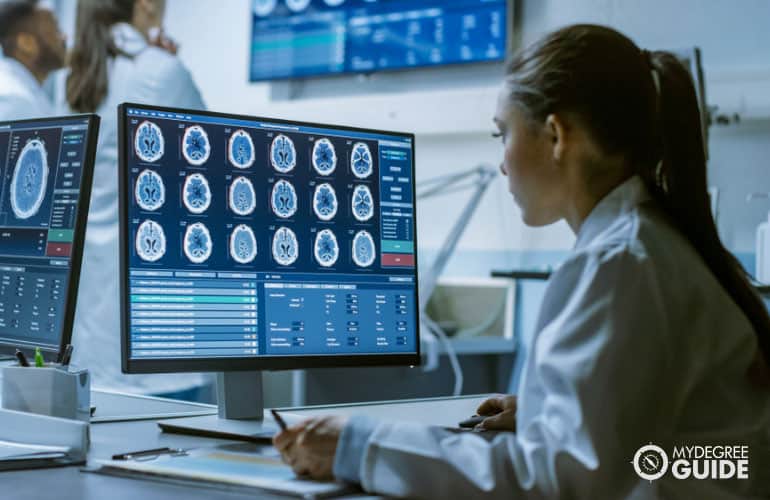
Are you interested in studying the ways that the brain affects the body and the body affects the brain? If so, consider studying the connections between biology and neuroscience in a biopsychology program.
This is a science-heavy discipline. You may take classes in anatomy and cell biology. You’re likely to take statistics classes and learn how to work with psychological data. The curriculum will also include studies in psychology; the topics may include developmental, social, cognitive, and comparative psychology.
Editorial Listing ShortCode:
This type of online psychology degree program can help you prepare for a degree as a neuroscience researcher; for example, you could study the ways that people learn new information. You may also go into comparative psychology or provide mental health counseling. For some positions, a doctoral degree, such as either a campus-based or an online PhD in Behavioral Psychology, may be required.
Counseling Psychology

To provide counseling services to a diverse group of clients, consider a master’s program that focuses on counseling psychology. During your workdays, you may talk to people with addiction problems, marital troubles, work stress, and other issues. You may choose to focus your services on kids, teens, or adults.
The curriculum may cover psychology topics like human development, psychological assessments, and social psychology. You might also gain new insight into the counseling process through classes on group therapy, counseling ethics, multicultural sensitivity, and family therapy.
Editorial Listing ShortCode:
Although this master’s degree won’t qualify you to practice as a psychologist, it may help you get an assistant or analyst position under the supervision of a licensed psychologist. The curriculum may prepare you to take a certification exam so that you may practice independently as a licensed counselor.
School Psychology

If you feel strongly about helping kids and teens work through their problems so that they can succeed in school, then you may have the makings of a great school psychologist. Completing this degree track may qualify you to practice as a school psychologist in your state.
The courses will often cover human development, statistics, educational psychology, behavioral assessments, and crisis interventions. You may also learn about providing services in multicultural settings, conducting assessments and evaluating the programs you implement.
Editorial Listing ShortCode:
School psychologists usually work in K-12 schools or local school districts. Meeting the requirements for licensure in your state may require completing extra hours on top of the credits for basic psychology master’s programs, so you may be in school for several years.
Social Psychology

Are you interested in studying how people interact with one another and their environments? Social psychology students study the ways that people’s surroundings play into their behavioral decisions.
Classes in social psychology address group dynamics, conflict resolution, cultural behaviors, and human development. You may learn how to study the data that others in the field have gathered and how to conduct original research. Drawing value and meaning from sets of data may be an important emphasis of this program.
Editorial Listing ShortCode:
The research-heavy focus of this program may come in handy because many social psychology students go on to become researchers who study human behavior and relationships. You may also choose to work directly with clients as a social worker, or you may become a political strategist who influences procedures and policies.
Sample Courses in a Masters in Behavioral Psychology Online Program


The curriculum for your master’s program may help prepare you to understand human thinking and behavior, conduct research, help people adjust their lives, and provide social and emotional supports. Your class list may contain courses similar to the ones below.
- Advanced Intervention: In this class, you’ll build on the counseling and therapy skills that you acquired during your undergraduate studies. You may learn to support clients suffering from PTSD and other types of trauma by performing assessments, offering counseling and linking people to community resources.
- Behavior Analysis: The behavioral principles that you learn in this course will equip you to pay attention to people’s behavior so that you’ll have the data and information that you need for creating strategic interventions. Behavior analysis can be particularly useful for people with delays and disabilities.
- Behavioral Modification: Once you’ve gathered and analyzed data about people’s behavior, the next step is to design personalized plans that address deficit areas. This course will provide strategies that you can use to help people adjust their typical actions or improve their relationships.
- Cognitive-Behavioral Therapy: This class will introduce you to the principles of cognitive-behavioral therapy, which is often known by the acronym CBT. You’ll talk about the science behind human thoughts, and you’ll learn how to use talk therapy to help people identify their negative or irrational thoughts and replace them with healthier ones.
- Research and Experimental Design: In a behavioral psychology program, you may learn a different approach to research and experimentation than you’ve experienced in the past. This course will introduce you to the concepts of defining behavior, measuring behavior, and observing how variable adjustments affect the outcome. You’ll also discuss ethics in experimentation.
- Science of Human Behavior: This advanced course covers hard-to-analyze situations in behavioral science. You may talk about the struggle of maintaining control in group settings or the inherent difficulty of evaluating behaviors that are conducted in private. The class may also address behavioral epidemiology and the factors that influence health outcomes.
In a behavioral psychology program, you may also have fieldwork requirements. You may complete practicums or serve as an intern for one or more semesters.
Certifications and Licenses a Master’s in Behavioral Psychology

To improve your chances of landing your ideal job, consider earning industry certifications after completing your master’s degree.
- Alcohol and Drug Counselor: Earning the ADC credential from the International Certification and Reciprocity Consortium requires passing a three-hour test. Achieving this certification may help you become a licensed drug counselor in your state.
- Board Certified Behavior Analyst: As a BCBA, you’ll qualify to practice independently as a behavior analyst, and you’ll be able to supervise behavior assistants and technicians. To receive this certification from the Behavior Analyst Certification Board, you must earn a graduate degree, accumulate work experience, and pass a test.
- Certified Co-Occurring Disorders Professional: The California Consortium of Addiction Programs and Professionals offers the CCDP credential to people who can demonstrate their expertise in working with clients who have both substance abuse disorders and mental health conditions. Certification is granted after you complete certain coursework, log a set number of work hours, and pass an exam.
- Licensed Behavioral Health Practitioner: The LBHP title is used in some states to identify professionals who are qualified to provide treatment for mental health or substance abuse disorders. These professionals may include licensed drug counselors, marriage therapists, psychologists, mental health counselors, and social workers.
- Veterans Behavioral Health Certificate: Offered through the National Council for Behavioral Health, this program improves your ability to offer supports to veterans. To qualify, you must take online courses and pass an exam.
Because pursuing additional credentials demonstrates your commitment to continual professional growth, both employers and clients may appreciate your efforts.
What Can I Do with a Masters in Behavioral Psychology?

With a master’s degree in behavioral psychology, you may choose to work as a counselor in schools, clinics, rehab centers, private practices or other settings. You might want to specialize in a particular type of therapy, such as marriage, addiction, or youth counseling.
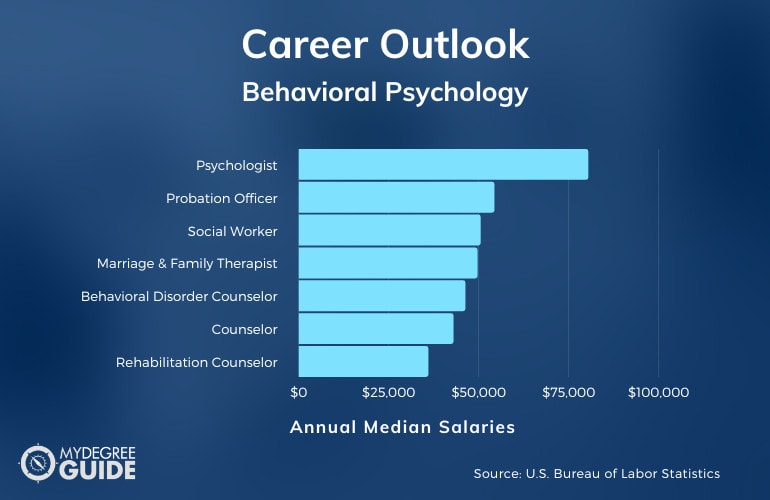
According to the Bureau of Labor Statistics, positions for counselors are on the rise; for example, the number of jobs for mental health and substance abuse counselors is expected to go up by 25% through the next ten years. Some careers in the behavioral psychology field include:
Psychologist

Annual median salary: $80,370
Studying psychology may put you on track to becoming a psychologist who conducts research or counsels clients. Although you may be able to do some psychology jobs, such as school psychology, with a master’s degree, you’ll typically need a doctorate for most licensed positions.
With your master’s, you may be able to work as an assistant to a licensed psychologist, and your degree might also help you achieve your goal of someday earning a psychology doctorate.
Probation Officer/Correctional Treatment Specialist

Annual median salary: $54,290
If you want to help people turn their lives around after getting caught up in the criminal justice system, then you might want to become a probation officer or a correctional treatment specialist. You may meet with offenders and check in on their progress.
You may need to conduct drug tests, consult friends or family members, create behavior plans, confirm employment status, and connect offenders to community resources. You might be employed by your local or state government.
Marriage and Family Therapist


Annual median salary: $49,610
Using the principles of cognitive-behavioral therapy may help people improve their relationships with one another. In individual and group sessions, you may help couples and family members identify their problem areas, find new ways of communicating with each other, and make choices that support the family unit.
This type of therapy may be particularly beneficial for those going through times of transition, such as marital separation, job loss, or the death of a loved one. You may have a private office where clients come to speak with you.
Social Worker

Annual median salary: $50,470
As a social worker, you may help people locate community services, get back on their feet and solve problems of daily living. You may be the main contact person who coordinates various care plans for your clients, or you may provide counseling services.
Having a master’s degree in behavioral psychology may qualify you to complete the process of becoming a licensed clinical social worker in your state. Licensure may bring increased responsibilities and pay. Many social workers are employed by schools, hospitals, human welfare departments, and private practices.
Substance Abuse/Behavioral Disorder Counselor

Annual median salary: $46,240
You may become a counselor who specializes in helping people break the habit of engaging in addictive or destructive behaviors. People with substance abuse disorders, alcoholism, and eating disorders often work with this type of counselor.
Your responsibilities may include evaluating patients, creating individualized treatment plans, and providing counseling throughout the treatment process. You might also work with family members or create prevention programs. As a behavior counselor, you may work in a drug rehab facility, a hospital, a school, a health clinic, or a private practice.
Counselor

Annual median salary: $42,930
As a counselor, you may help people work through their struggles and personal problems. You may become a mental health counselor who focuses on treatment for a variety of mental and emotional disorders. Other possible areas of specialization may include personal relationships, work stress, addiction issues, grief, and trauma, or youth counseling.
With your assistance, patients may begin to adjust their behaviors and improve their interactions with others. Your counseling practice may be based in a health clinic, a non-profit agency, or a private office.
Rehabilitation Counselor

Annual median salary: $35,950
Your responsibilities as a rehabilitation counselor typically involve helping people increase their independence. Also, you may be in charge of coordinating care or connecting clients to community resources. You may work with the elderly, people who have disabilities or those who are transitioning out of substance abuse treatment.
The support that you provide may help people learn to manage daily tasks or maintain steady employment. You may work in a long-term care or residential facility, a community agency, a veterans’ center, or a senior center.
Professional Organizations in Behavioral Psychology


If you’re looking for a behavioral psychology mentor or want to connect with others who apply the principles of behavioral psychology in their professional lives, then you may want to join an industry organization.
You may receive access to websites, publications, discussion groups, online classes, conferences, and other resources.
- American Psychological Association: This group has over 110,000 members who work in all aspects of psychology, including research, teaching, and counseling. One of the primary ways that APA assists psychology professionals is by advocating for the field in public and political settings. You can receive specialized support by joining one of the organization’s divisions.
- Association for Behavior Analysis International: As a behavioral psychology student, you’ll particularly benefit from networking with the like-minded professionals in this organization. ABAI’s scholarly journals and annual events are valuable sources of information. You may want to look into the group’s local chapters and special interest groups.
- Association for Psychological Science: Through journals, conferences, and advocacy, APS works to increase people’s understanding of psychology as a science. This worldwide organization welcomes members whose professional focus is on research, academics, clinical practice, or other aspects of the field.
- International Society for the Study of Behavioural Development: ISSBD members are committed to learning more about human development and behavior. The organization holds meetings and workshops, issues grants to members, publishes books and journals, and offers networking tools.
- National Alliance of Professional Psychology Providers: If becoming a clinical psychologist is your goal, then NAPPP membership may be a good fit for you. This association is committed to supporting psychologists who provide clinical services. Membership benefits include continuing education credits, certification programs, advocacy, and tools for expanding your practice.
- National Association of Cognitive-Behavioral Therapists: NACBT is dedicated to furthering the field of cognitive-behavioral therapy. The group provides information on CBT for the general public and offers a membership program for CBT students and professionals. Benefits of joining include a newsletter, a resume-posting board, and a variety of discount opportunities.
Grad school is a great time to join these groups because you can often receive special membership rates as a student.
How Do You Become a Behavioral Psychologist?


Earning the credentials to practice as a behavioral psychologist requires getting a doctoral degree. Here are the steps to become a behavioral psychologist.
- Earn a bachelor’s degree, preferably in psychology or a related field.
- Pursue a master’s degree. Although sometimes optional, a master’s degree in psychology can streamline the process of earning a doctorate.
- Enroll in a doctoral program in behavioral psychology.
- Complete a one-year doctoral internship.
- Finish your doctoral program with a dissertation. In some cases, a dissertation is not required. Instead, a capstone project will be completed.
- Gain postdoctoral experience. After earning your doctorate, you’ll need a few years of supervised work experience before licensure.
- Take the Examination for Professional Practice in Psychology (EPPP).
- Apply for state licensure.
- Gain additional certifications to demonstrate your expertise in behavioral psychology.
Requirements for licensure are set by individual states, so consult your state’s board for details.
Accreditation

To ensure that you may be prepared for certification exams and the workforce, it’s important to attend an accredited college.
Regional accreditation is granted to the school to affirm the quality of its academic programs and organizational structure. This accreditation can only be granted by one of the six regional accreditors that are approved by the Council for Higher Education Accreditation (CHEA).
Programmatic accreditation is given to specific degree programs. By attending an accredited school, your curriculum will likely cover the topics that are needed for your licensure exams. A degree from an accredited program may also help you get a good job.
In the field of behavioral psychology, programmatic accreditation may come from:
- American Psychological Association
- Association for Behavior Analysis International
- National Association of School Psychologists
Whether earned online or on-campus, degrees from accredited programs are duly respected by other universities and employers alike.
Financial Aid


Getting a degree in behavioral psychology doesn’t have to drain your bank account. Financial assistance from the following sources may make going back to school a more affordable endeavor.
- Grants: From the state or federal government
- Loans: From the government or private sources
- Scholarships: Based on merit or financial need
- Fellowships: Often granted by industry organizations
- Work-study: In conjunction with the government and your school
Compiling a financial aid package that includes multiple funding sources may help you significantly reduce your tuition obligations. To begin the process, fill out the Free Application for Federal Student Aid (FAFSA).
How Long Does It Take to Get a Master’s in Behavioral Psychology?
As a full-time student, you may be able to earn your master’s degree in two years or less, especially if you choose an online accelerated psychology degree program. On the other hand, internship requirements may extend the length of your program, and school psychology programs often take at least three years.
How Much Is a Master’s in Behavioral Psychology?


Tuition costs vary widely depending on whether you attend an in-state, out-of-state, or private school, but they may fall in the range of $10,000 to $20,000. Scholarships, grants, and loans may help make graduate school more affordable. To help you keep up with expenses, consider taking online classes while maintaining your full-time job.
What Careers Can I Get with a Behavioral Science Degree?
With a master’s in behavioral science, you may be eligible to seek state licensure as a substance abuse, marriage and family, behavioral disorder, or mental health counselor. You may also work in a clinical psychology setting as an analyst or an assistant who practices under the direction of a licensed psychologist.
Ready to Move Forward?
To advance your career in the growing fields of counseling and psychology or work your way toward a doctorate, you may start by pursuing a master’s degree in behavioral psychology. Submitting applications to online programs is the first step toward an education that may better your own life and that of your clients’ lives.
Related Guides: