Explore online computer science associate degree programs. Compare schools and learn what you can do with an associate’s degree in computer science.

The Bureau of Labor Statistics predicts that jobs in computer science and information technology will rise by 11% over the next 10 years. To secure your spot in this growing field, a college education is a must.
Editorial Listing ShortCode:
You can get started by earning an associate’s degree online in computer science.
Universities Offering Online Computer Science Associate Degree Programs
Methodology: The following school list is in alphabetical order. To be included, a college or university must be regionally accredited and offer degree programs online or in a hybrid format.
1. Allan Hancock College
Allan Hancock College is named after George Allan Hancock and can be found on 105 acres of land in Santa Maria, California. It was established in 1920. It is also known as AHC and is a part of the California Community Colleges System. It was started by the School District of Santa Aria.
There are a total of 16 male and female varsity sports teams, including basketball, tennis, soccer and women’s volleyball, to name a few.
- AA in Computer Science
Allan Hancock College is accredited by the Accrediting Commission for Community and Junior Colleges.
2. Anne Arundel Community College
The Anne Arundel Community College can be found in Arnold, Maryland and was established in 1961. The campus took its current 230-acre home in September of 1967.
- Computer Science Transfer – Computer Science, A.S.
Anne Arundel Community College is accredited by the Middle States Commission on Higher Education.
3. Bristol Community College
Bristol Community College is located in Fall River, Massachusetts. It is a public community college that was established in December of 1965. Its main campus is located on a 65-acre property, and other campuses can be found in New Bedford and Attleboro.
The college competes in varsity men’s and women’s soccer, basketball, and men’s golf.
- Associate in Science in Computer Information Systems Transfer (Computer Science Transfer Concentration)
Bristol Community College is accredited by the Commission on Institutions of Higher Education of the New England Commission on Higher Education.
4. Bucks County Community College
Bucks County Community College’s main campus can be found in Newtown, Bucks County, Pennsylvania. It was established in 1964 and has a total of three physical campuses and offers online courses as well.
The college was added to the National Register of Historic Places in 1987.
- Associate of Science in Computer Science
Bucks County Community College is accredited by the Middle States Commission on Higher Education.
5. Central Texas College
Central Texas College is located in Killeen, Texas and was established in 1965 by Central Texas citizens. The campus can be found on a lot of land that measures 500 acres. Due to its proximity to the Fort Hood Army Installation, the college caters to the military.
- Associate of Science in Computer Science
Central Texas College is accredited by the Southern Association of Colleges and Schools Commission on Colleges.
6. Coffeyville Community College
Coffeyville Community Colleges can be found in Kansas and was established in 1923. The college is a member of the NCAA with athletic teams Red Ravens participating in football, baseball, basketball, softball, track and field, and more. It is also a member of the Kansas Jayhawk Community College Conference.
- Associate in Arts in Computer Science
Coffeyville Community College is accredited by the Commission on Institutions of Higher Education of the North Central Association of Colleges and Schools.
7. Colorado Christian University
Colorado Christian University offers an Associate of Science in Computer Science that can be earned 100% online. Courses are 5, 7, or 10 weeks long, and students usually take just one at a time. Students can potentially finish the program in less than 2 years. CCU provides small class sizes and individualized attention.
- AS in Computer Science
Colorado Christian University is accredited by the Higher Learning Commission.
8. Community College of Baltimore County
Gaining higher education from the public Community College of Baltimore County Maryland gives students the ability to achieve personal and career advancement. CCBC opened in 1998 and has grown to be able to serve students from around the globe.
- AS in Computer Science
Community College of Baltimore County is accredited by the Middle States Commission on Higher Education.
9. Cowley County Community College
The main campus of the Cowley County Community College is in Arkansas City in Kansas. It also has other locations in Downtown Wichita, Mulvane, Winfield, and Wellington. The college participates in several NJCAA sports, including cross country, volleyball, tennis, and more.
- Computer Science (AS degree)
- Computer Information Science (AA degree)
Cowley County Community College is fully accredited by the Higher Learning Commission.
10. Delaware County Community College
The Delaware Count Community College can be found with the main campus in the Philadelphia area but has several locations elsewhere in Pennsylvania. The college was established in March of 1967.
It is home to the NJCAA Phantoms, which belong to the Eastern Pennsylvania Collegiate Conference and the Pennsylvania Collegiate Athletic Association.
- Computer Science, A.S.
Delaware County Community College is accredited by the Middle States Commission on Higher Education.
11. Faulkner University
Faulkner University is located in Montgomery, Alabama and was established in 1942. It is A Christian University that was founded by Dr. Rex Turner, Joe Greer, and Dr. Leonard Johnson. It was originally known as the Montgomery Bible School.
It participates in NAIA sports events. They are former NCCAA national championship baseball winners.
- Associate of Science in Computer and Information Science
Faulkner University is accredited by the Commission on Colleges of the Southern Association of Colleges and Schools.
12. Franklin University
Franklin University has its main campus in Columbus, Ohio’s downtown and was established in 1902. It is a private university that was founded to provide services to adult students in the area. There are now several location centers across the Midwestern States, namely Wisconsin, Pennsylvania, Illinois, and Indiana.
- AS Computer Science
Franklin University is regionally accredited by the Higher Learning Commission.
13. Georgia Military College
Georgia Military College can be found in Milledgeville, Georgia. It is primarily a military-focused college but includes a middle school, a high school, a junior college, and a military junior college program. You will find its main facility in the Old Georgia State Capitol building that has been restored.
- Associate of Science in Computer Science
Georgia Military College is accredited by the Southern Association of Colleges and Schools Commission on Colleges.
14. Georgia State University
Georgia State University was established in 1913 and is one of 4 research universities that can be found in Georgia. It was initially intended to be a night school.
A total of 16 varsity teams compete in the NCAA Division competitions. Sports include basketball, baseball, golf, softball, soccer, women’s tennis, and beach volleyball.
- Computer Science Pathway, A.S.
Georgia State University is accredited by the Southern Association of Colleges and Schools Commission on Colleges.
15. Hawaii Pacific University
Hawaii Pacific University can be found in Honolulu and Kaneohe in Hawaii. It is a private, nonsectarian University and is the largest of its kind in the central Pacific. It was established as the Honolulu Christian College in 1966 and later became the Hawaii Pacific College with the granting of a new charter.
- Associate of Science degree in Computer Sciences
Hawai’i Pacific University is accredited by the WASC Senior College and University Commission.
16. Hazard Community and Technical College
This community college can be found in Hazard, Kentucky. It was founded in 1968 and currently has five campuses. These campuses can be found in Hazard, Jackson, Leslie County, and Knott County.
- Associate of Applied Science in Computer and Information Technologies
Hazard Community and Technical College is accredited by the Southern Association of Colleges and Schools Commission on Colleges.
17. Iowa Western Community College
The Iowa Western Community College can be found in Council Bluffs, Iowa. It was established in 1967 and now has campuses in other parts, including Harlan, Atlantic, Shenandoah, and Clarinda.
The sports teams here go by the nickname the Eivers and include men and women’s teams for a wide range of sports. They participate in NJCAA and have won several championships.
- Associate of Arts Management Information Systems
Iowa Western Community College is regionally accredited by The Higher Learning Commission.
18. Ivy Tech Community College
The Ivy Tech Community College is based in Indiana and often goes by the shortened name, Ivy Tech. The college now has more than 40 locations after being established in 1963. It is the largest post-secondary school in the state and the largest accredited statewide community college.
- Associate of Science in Computer Science
Ivy Tech Community College of Indiana is accredited by the Higher Learning Commission of the North Central Association of Colleges and Schools.
19. Jamestown Community College
Jamestown Community College is located in New York. It was established in 1950 as the first community College for the system of the State University of New York.
Situated on a 107-acre property, it is just 50 miles east of Jamestown in Olean, New York. The satellite “Warren Center” was opened in 1987 just 25 miles south of the main location.
- AS Computer Science
Jamestown Community College is accredited by the Middle States Commission on Higher Education.
20. Kingsborough Community College
This is a public community college in Manhattan Beach. It is a member of the CUNY system and is the only community college to be found in Brooklyn. Founded in 1963, the Kingsborough Community College was recognized as one of the top 10community colleges in the country by Niche.
- Associate in Science Computer Science
Kingsborough Community College is fully accredited and approved by the Middle States Commission on Higher Education.
21. Lawson State Community College – Birmingham
This community college in Birmingham, Alabama is historically black. It is a part of the HBCU community college system and was established in 1949. It is affiliated with the Alabama Community College System.
College alumni proudly participate in the Alabama Community College Conference for athletic performance events. Their teams are nicknamed the Cougars.
- Computer Science – Business – AAS Degree
Lawson State Community College is accredited by the Southern Association of Colleges and Schools Commission on Colleges.
22. Lincoln Land Community College
This community college is a public community college that was established in 1967. It can be found in Springfield, Illinois and has several extended branches in other locations. The college has athletic teams called the Lincoln Land Loggers, who participate in several intercollegiate athletics of the NJCAA.
- Computer Information Systems: Associate in Arts
- Computer Systems: Associate in Applied Science
LLCC is accredited by the Higher Learning Commission.
23. Lone Star College
This public community college system serves Greater Houston’s northern communities. It is the biggest institution in the Houston area and is one of the United States’ fastest-growing institutions of higher education.
It was established in 1972 as North Harris County College with classes beginning in 1973. The new name was adopted in 1991.
- Associate of Science in Computer Science
Lone Star College is accredited by the Southern Association of Colleges and Schools Commission on Colleges.
24. Lord Fairfax Community College
Lord Fairfax Community College (LFCC) is a public community college that can be found in the Piedmont area, more specifically in the Shenandoah Valley region of Virginia. It is one of the colleges in the Virginia Community college system. Established in 1970, the college offers certificate and associate degree programs.
- Associate of Science Degree in Computer Science
Lord Fairfax Community College is accredited by the Commission on Colleges of the Southern Association of Colleges and Schools.
25. Metropolitan Community College
Metropolitan Community College is a member of the Missouri community college system. It is the oldest of the group, being founded in 1915.
This community college was one of the first schools in the country to offer 2-year associate degree programs. In 1918, the college was accredited by the North Central Association of Colleges and Schools. Its name was changed in 1919.
- Associate in Computer Science degree
Metropolitan Community College is accredited by the Higher Learning Commission.
26. Monroe Community College
This public community college can be found in Munroe County in New York. It is one of two, with the main campus being in Brighton and the second being in Rochester. The main campus in Brighton sits on 300 acres of land. The Monroe Community College athletic teams are known by the nickname “The Tribunes.”
- Computer Science, A.S. (Hybrid)
Monroe Community College is accredited by the Middle States Commission on Higher Education.
27. Montgomery College
Montgomery College in Maryland is a public community college. It has three campuses: in Rockville, Germantown, and Takoma Park. It was established in 1946 when it was known as the Montgomery Junior college. The athletics teams of the college are nicknamed “The Raptors,” and they compete in the NJCAA.
- Computer Science and Technologies AA
Montgomery College has been accredited by the Middle States Commission on Higher Education.
28. Montgomery County Community College
Montgomery County Community College is also known as Montco, MCCC, or MC3. It is a public community college located in Pennsylvania. The college was established in 1964 with a campus in Conshohocken. It later relocated to its current location in 1972, where it now sits on 186 acres of land in Blue Bell.
- Associate of Science in Computer Sciences
Montgomery County Community College is fully accredited by the Middle States Commission on Higher Education.
29. Northern Essex Community College
Located in Essex County, Massachusetts, this community college draws students from the surrounding area of the state as well as the southern portion of New Hampshire. It enrolls 6,000 students per year, with 70 available programs.
Besides offering a variety of sports for both men and women, the school also hosts a police academy and a sheriff’s academy.
- Associate in Science in Computer and Information Sciences
Northern Essex Community College is accredited by the New England Commission of Higher Education.
30. Northwest College
Northwest College was formerly known as the Northwest Community College and has the motto, “Your future, our focus.” It was established in 1946 and can be found just 70 miles from the popular Yellowstone National Park in Powell, Wyoming.
- Computer Science, A.S.
Northwest College is accredited by the North Central Association of the Higher Learning Commission.
31. Ocean County College
Ocean County College is a public community college that can be found in New Jersey’s Tom’s River area. The college was established in 1964, and it has since grown to have other locations. It is affiliated with the Amateur Athletic Union as well as the MAISA.
- Associate of Science in Computer Science
OCC is accredited by Middle States Commission on Higher Education.
32. Palomar College
Palomar College is located in San Diego County in California. It is a public community college with its main campus found in San Marcos. There are additional sites in North San Diego County as well.
The college was established in 1946 with a motto of “Learning for Success.” The college has 22 men’s and women’s combined sports teams.
- Associate of Science Computer Science Information Technology
Palomar College is accredited by the Accrediting Commission for Community and Junior Colleges of the Western Association of Schools and Colleges.
33. Panola College
Panola College serves the areas of Marion County, Panola County, Shelby County, and Harrison County, excluding the Hallsville Independent School territory.
This public community college can be found in Carthage, Texas. It was founded in June of 1947, and it began classes in January of 1948. It has been operating at its current location since then.
- AAS in Computer Information Technology
Panola College is accredited by the Southern Association of Colleges and Schools, Commission on Colleges.
34. Park University
Park University is located in Parkville, Missouri. This private university was established in 1875 and was originally known as Park College. The original college had an arrangement for students to receive tuition and board in exchange for working a half a day on the college’s farm.
Athletic teams at Park University are known as “The Pirates.” They participate in NAIA and AMC competitions.
- Associate of Science in Information and Computer Science
Park University is accredited by the Higher Learning Commission.
35. Rogers State University
This public university can be found in Claremore, Oklahoma and has branches in Pryor Creek and Bartlesville. It was established in 1909 and is affiliated with the Board of Regents of the University of Oklahoma. Their motto is “Tradition Innovation Excellence.” They are a candidate for the NCAA Division II.
- Associate of Science in Computer Science
Rogers State University is accredited by the Higher Learning Commission of the North Central Association of Colleges and Schools.
36. Saint Paul College
This public community college can be found in Saint Paul, Minnesota. It is a member of the Minnesota State Colleges and University System. Founded in 1910, it was first a vocational high school for boys. It made the current facility its home in 1966, and at the time, its name was changed to the Saint Paul Technical Vocational Institute.
- Computer Science Transfer Pathway Associate of Science (AS) Degree
Saint Paul College is accredited by the Higher Learning Commission.
37. Seminole State College
Seminole State College features four Central Florida campuses, which makes it the 8th largest member of the Florida College System. The college was established in 1965 and was named Seminole Junior College at the time. It had a name change in 1971 to Seminole Community College, and in 2009, it was renamed Seminole State College.
- Computer Science Pathway Associate in Arts
Seminole State College of Florida is accredited by the Southern Association of Colleges and Schools Commission on Colleges.
38. South College
South College offers an online program for an Associate of Science in Computer Science. The curriculum emphasizes hands-on learning and problem-solving and is kept up to date with the latest industry trends. Online students are given opportunities to collaborate with classmates and have access to tutoring and other resources.
- AS in Computer Science
South College is accredited by the Southern Association of Colleges and Schools Commission on Colleges.
39. South Texas College
This Rio Grande Valley College is a public community college. It receives its accreditation from the Commission on Colleges of the Southern Association of Colleges and schools. It was established in September 1993. As per Texas Senate Bill 251, the official service area of the South Texas College includes Starr and Hidalgo counties.
- AS in Computer Science
South Texas College is accredited by the Southern Association of Colleges and Schools Commission on Colleges.
40. Southern New Hampshire University
Starting in 1932, Southern New Hampshire University is a large private school that has a diverse population. This global reaching school offers hundreds of programs that lead to an undergraduate, graduate, or doctoral education in a variety of academia.
Southern New Hampshire University prides itself on providing one of the most affordable tuitions in the nation. Online bachelor’s degree options include Community Health Education, Computer Science, Criminal Justice, Cyber Security and Data Analytics.
- AS in Computer Science
Southern New Hampshire University is accredited by the New England Commission of Higher Education.
41. St. Charles Community College
St. Charles Community College was established in 1986 and had its first semester in 1987. It is a public community college that can be found in St. Charles, Missouri. They are 15-time national champions for Roller Hockey, and other club sports there include basketball and cheerleading. They are a member of the NJCCA Division I.
- Associate of Arts in Computer Science
St. Charles Community College is accredited by the Higher Learning Commission of the North Central Association of Colleges and Schools.
42. St. Petersburg College
This Pinellas County public college was established in 1927. It was established as a private junior college, the first of its kind in Florida. But St. Petersburg College is now a public college. It has several campuses through Pinellas county for a total of 11, plus some smaller learning centers as well.
- Computer Information Technology A.S. Degree
St. Petersburg College is accredited by the Southern Association of Colleges and Schools Commission on Colleges.
43. Thomas Edison State University
Thomas Edison State University can be found in Trenton, New Jersey. It is a public university with a majority of online enrollment. It was officially established in July of 1972. The original building was home to three other schools before becoming the Thomas Edison State University headquarters. It was awarded University status in 2015.
- Associate in Science in Natural Sciences and Mathematics (ASNSM) degree in Computer Science
Thomas Edison State University is regionally accredited by the Middle States Commission on Higher Education.
44. Thomas Nelson Community College
Thomas Nelson Community College has two campuses in James City County. The building project on the original campus was initiated in 1967, and in 1968, students were able to begin classes. A part of the Virginia Community College System, TNCC serves those living in the Hampton Roads Peninsula region.
- Associate of Science in Computer Science
Thomas Nelson Community College is accredited by the Southern Association of Colleges and Schools Commission on Colleges.
45. Tompkins Cortland Community College
This is a public community college located in Dryden, New York. Established in 1967, the Tompkins Cortland Community College was opened in 1968 in Groton. In 1974, the college moved to its current location, and new facilities were added in 2007. They are home to the Panthers, who participate in Division III NJCAA sports.
- Computer Information Systems A.A.S. Degree
Tompkins Cortland Community College is accredited by the Middle States Commission on Higher Education.
46. Trinity Valley Community College
Trinity Valley Community College can be found in Athens, Texas. It is a public community college with four campuses that serve five southeast and eastern counties in the state of Texas. Founded in 1946, it was first known as the Henderson County Junior College in Athens. It received its current name in September of 1986.
- Associate of Arts Liberal Arts Degree with an emphasis in Computer Science
TVCC is accredited by the Southern Association of Colleges and Schools Commission on Colleges.
47. Ulster County Community College
Ulster County Community College is also known as SUNY Ulster and is a public community college. The main campus is in Stone Ridge in New York while also having facilities in Kingston. The college was established in 1961 and is affiliated with the NJCAA Region III as well as the Mid Husdon Conference.
- Computer Science, A.S.
SUNY Ulster is accredited by Commission on Higher Education of the Middle States Association of Colleges and Schools.
48. Wallace State Community College
This Hanceville, Alabama community college was established in 1966. It was first known as the George C. Wallace State Trade School of Cullman County. It offers a range of associate degrees and participates in sports such as basketball, baseball, golf, softball, volleyball, intramurals, and cheerleading.
- Associate in Applied Science Computer Science
Wallace State Community College is accredited by the Southern Association of Colleges and Schools Commission on Colleges.
48. Weber State University
Weber State University can be found north of Salt Lake City in Ogden, Utah. Founded in 1889 under the name Weber Stake Academy, the name has changed a couple of times; in 1933, 1962, and 1991, when it received its current name.
- Associate of Applied Science in Computer Science
Weber State University is accredited by the Northwest Commission on Colleges and Universities.
50. Western Nebraska Community College
Western Nebraska Community College was founded in 1926 and features athletic teams under the name “Cougars”. The college has previously been known by a couple of names before arriving at its current designation.
It has two campuses in Sidney as well as in Alliance. Initially, the campus became inactive and was reopened in 1929. It became a public college in 1932. It changed to its current name in 1968.
- Associate of Science in Computer Science
Western Nebraska Community College is fully accredited by the Higher Learning Commission.
Online Computer Science Associate Degree Programs
Some schools offer a computer science associate’s degree with a particular area of focus.
Click on the area that you’re most interested in to jump to that section.
The concentration that you choose may influence what jobs you’ll be ready for after graduation and which bachelor’s degree you should earn next.
Computer Science

For a broad overview of all that computer science has to offer, consider one of the many generalist degree programs that are available. Your classes may include Fundamentals of Computer Networks, Introduction to Programming Languages and Database Systems.
You can explore topics like computer architecture, computer programming, data structures, cybersecurity, and operating systems. Additionally, you can refine your math, science and critical thinking skills.
Editorial Listing ShortCode:
A general associate’s degree can help get you ready for nearly any traditional or online bachelor’s in computer science. Or, if you are interested in the general field of computers and information technology, you may want to pursue a PhD in computer science. You could also use your associate’s degree to get started in computer programming or database design.
In addition to getting an entry-level or assistant job in those areas, you might be able to help people troubleshoot their technology problems, analyze computer efficiency, or install software programs.
Computer Programming

When you study computer programming, you can learn about coding and programming languages. These may include C++ and Visual Basic.
Your knowledge of coding and programming can equip you to solve problems that arise in computing situations. To help with that goal, you’ll also need to study math and critical thinking skills. Plus, your courses should cover how to design databases and how to develop websites.
Editorial Listing ShortCode:
People who select a computer programming track often have their sights set on becoming programmers. If that describes you, you may be glad to know that this degree can open doors to entry-level programming jobs. You could also become a web developer or a computer support technician.
Transferring your associate’s credits into a computer programming bachelor’s program can help you advance beyond entry-level positions.
Information Technology

When you enroll in an IT track, you can expect to learn about the technologies that organizations use for networks and databases. You may take classes like Database Management, Switching and Routing for Networks, and Introduction to Programming.
Topics that you’ll cover for this degree may include cybersecurity and artificial intelligence. To prepare you for success in a business setting, your classes may also discuss technology risks and project management.
Editorial Listing ShortCode:
As a graduate, you could use your associate’s degrees to help you secure a helpdesk job; you may assist individuals with computer problems or serve as a reference for companies with network troubles. You might also be able to find a job as a database or network administrator for a small company.
If you want to continue your education, this degree can help prepare you for a bachelor’s program in IT or web development.
Software Development

Whether on phones, computers, tablets, smart speakers, or household devices, Americans rely on software and applications every day. To learn the skills for building these programs, consider earning your associate degree in software development.
You can’t develop software without knowing programming languages, so you’ll probably learn one or more during your time in school. These might include Java, Python, Visual Basic or C++. You may study both client-side and server-side tools, and you should also discuss how to design programs that are easy for users to navigate.
Editorial Listing ShortCode:
Companies often need custom applications and programs for their employees or their customers, so you could assist in building those systems. With an associate’s degree, you could also be a web designer or an IT professional who oversees software updates for an organization’s computers.
At the bachelor’s level, you could continue studying software development or enter a computer engineering or computer science program.
Associates in Computer Science Careers & Salaries

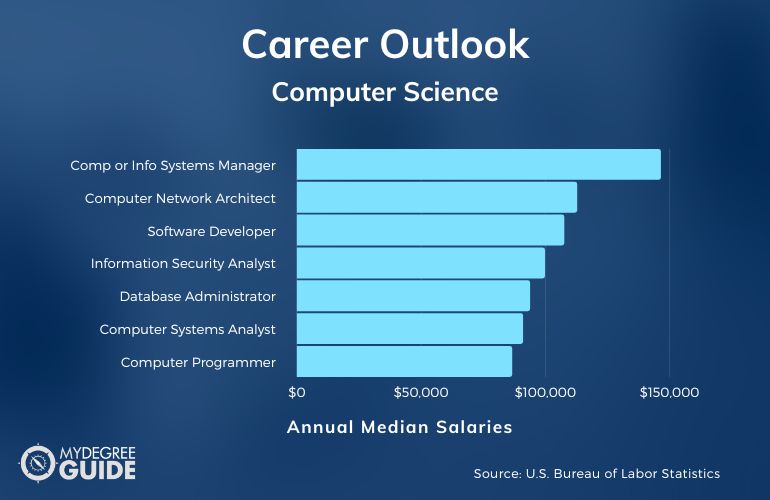
Computer and technology jobs are on the rise. An associate’s degree can help you be on your way to a promising career in this field.
Your two year degree can prepare you for entry-level jobs as well as give you the foundation you need for further education at some of the best colleges for computer science.
According to the U.S. Bureau of Labor Statistics, jobs in computers and information technology pay an average annual salary of $88,240.
| Computer Science Careers | Median Annual Salary |
| Computer or Information Systems Manager | $146,360 |
| Computer Network Architect | $112,690 |
| Software Developer | $107,510 |
| Information Security Analyst | $99,730 |
| Database Administrator | $93,750 |
| Computer Systems Analyst | $90,920 |
| Computer Programmer | $86,550 |
| Network or Computer Systems Administrator | $83,510 |
| Web Developer | $73,760 |
| Computer Support Specialist | $54,760 |
These average salary figures take into account employees of all degree levels. Right after earning your associate’s degree, you may be on the lower end of the pay scale. In fact, you may need to take an assistant or technician role under the supervision of someone with a bachelor’s or master’s degree.
Over time, earning more experience and education can help you advance your career and start earning more money.
Choosing a Online Computer Science Associate Degree

Many colleges offer online programs in computer science, so you’ll need to narrow down the selection before you send in applications. Comparing schools’ offerings can help you make a decision about which associate degree program might be a good fit for you.
- Accreditation – Any school you choose should hold regional accreditation.
- Course list – Curriculum can vary widely from one school to the next, so choose a program with intriguing classes.
- Hands-on opportunities – Some programs have practicums or online simulations that allow you to build computer systems or try out software programs.
- Online format – Different schools take different approaches to online studies. For example, some may require you to log in at certain times, and others are asynchronous, meaning that you can access the course materials on your own schedule. Some programs may require that you come to campus occasionally.
- Program offerings – Some colleges have two-year computer science degrees while others offer information technology or computer programming.
- School calendar – Although many schools stick with traditional semesters, others offer accelerated schedules with year-round classes.
- Student supports – An online program may have options for tutoring, club participation or library services.
- Transfer opportunities – Some associate degree programs in computer science are Associate of Applied Science (AAS) degrees that aren’t necessarily designed for full transfer into a bachelor’s degree program. You will probably be able to move into a bachelor’s degree program more easily if you earn an Associate of Science (AS), and some two-year programs may even have transfer agreements with four-year colleges.
- Tuition costs – The price per credit hour is higher at some schools than others, and prices are often lower at community colleges or state schools.
If you have questions about whether a particular college is suitable for your goals, reach out to the school’s admissions department.
Associate’s in Computer Science Curriculum & Courses

During a two-year degree computer science program, students are commonly introduced to fundamental concepts in networking, software, and hardware and database management. Your curriculum may be similar to the list of classes below.
- C++ Programming – Most associate degree programs cover at least one programming language, and C++ is a popular choice.
- College Calculus – Computer studies often require a strong understanding of mathematics, so you may need to take precalculus, calculus or business math classes.
- Computer Security – This class teaches how to protect computers and networks from cyber threats and maintain the integrity of customers’ data.
- Data Structures – This class may cover algorithms and modeling as well as various arrangements for data structures, such as stacks and queues.
- Fundamentals of Programming – This course covers the principles of computer language. Those concepts can apply to many of the programming languages that you may learn during your career.
- Information Literacy for the Digital Age – This course can give you opportunities to practice finding information and evaluating the reliability of sources and content.
- Introduction to Databases – Organizations often use database systems to record and organize their information, and this class introduces the principles for using and building databases.
- Networking – You can how to connect computers through networks, learn tips for troubleshooting, and discuss ways to protect systems from infiltration.
- Organization of Computer Systems – In this introduction to computer architecture, you can study hardware, and you may get to practice assembling components.
- Project Management – This course can equip you with skills for seeing projects through from beginning to end and coordinating a team of contributors.
Your program may have a practicum component in which you engage in hands-on work, or you may even have internship opportunities.
Admissions Requirements

Once you’ve narrowed down your school selection, it’s time to think about how to get into your top choices.
The first thing to consider before assembling your application packet is whether you meet the admissions requirements. If you’re unsure about your qualifications, contact the admissions department for more information.
Once you determine that you meet the requirements, you can start assembling your application materials and submitting them to colleges. The list below highlights some common components of admissions packets for two-year programs.
- Academic history – Whether you have a high school diploma or a GED, you’ll need to furnish evidence of that accomplishment. The school may consider your high school GPA when determining whether to admit you. If you’ve taken any college classes, you should also submit those transcripts.
- Application – Filling out this form will give the school basic information about you, such as your full name, date of birth and contact details. It may also include a space for you to indicate your academic goals.
- Fee – Some schools require a small fee to process your application.
- Placement tests – Two-year colleges often administer placement tests to assess students’ math and writing levels. You may not need to take these until after you are accepted.
Admission requirements vary among schools, so pay close attention to what each school needs to see. Some two-year programs have open admissions policies, but others are much more selective and also require letters of recommendation, work history, essays or standardized test scores.
Computer Science Professional Organizations


As a student, you can start building your professional connections by joining an industry organization. Special student rates may be available.
- Association for Information Science and Technology: ASIS&T brings together not only computer scientists but also information professionals from the fields of librarianship, data science, technology, healthcare, and more. The group has regional chapters throughout the world and student chapters at select universities.
- Association for Computing Machinery: Practitioners, researchers, and educators in computer science are invited to join ACM for access to digital resources, advocacy, and professional support. The group awards grants and fellowships each year. Members subscribe to a code of ethics.
- Association for Women in Computing: Females with an interest in computer-related careers support one another through membership in AWC. Local chapters hold monthly meetings and independent memberships are available as well.
- IEEE Computer Society: IEEE exists to help computer scientists and computer engineers improve their professional skills, make contributions to their fields, and develop connections with one another.
Members may have access to meetings, journals, articles, webinars, or conferences.
Accreditation
Regional accrediting organizations evaluate colleges to determine whether they do a good job of educating students. Schools that meet their standards receive a mark of approval called regional accreditation.
The Council for Higher Education Accreditation (CHEA) allows seven U.S. organizations to issue regional accreditation.
- Accrediting Commission for Community and Junior Colleges (ACCJC) Western Association of Schools and Colleges
- Higher Learning Commission (HLC)
- Middle States Commission on Higher Education (MSCHE)
- New England Commission of Higher Education (NECHE)
- Northwest Commission on Colleges and Universities (NWCCU)
- Southern Association of Colleges and Schools Commission on Colleges (SACSCOC)
- WASC Senior College and University Commission (WSCUC)
Online colleges are eligible for regional accreditation just like brick-and-mortar schools are.
Financial Aid

Associate’s degree students who attend regionally accredited schools may be eligible for state or federal financial aid. Your assistance package could include grants, loans, or work-study. Submitting the Free Application for Federal Student Aid (FAFSA) can help you learn more about your options.
Scholarships and fellowships are another way to finance your education. Some scholarship programs are available exclusively to computer science students, and others are specifically for students who are working toward an associate’s degree.
Computer Science Scholarships

Some scholarship funds are designated specifically for students who are studying computing or technology topics. If you have your sights set on an associate degree in computer science, consider applying for some of these awards. Your academic goals and your interest in technology may help you become a top contender.
- (ISC)² Undergraduate Cybersecurity Scholarship – Through the Center for Cyber Safety and Education, (ISC)² gives up to 20 scholarships each year to students in information security disciplines; each is worth $1,000 to $5,000.
- AACE International Competitive Scholarships – The Association for the Advancement of Computing in Education offers scholarships that cover the cost to attend an AACE conference and access to digital publications and other resources for one year.
- Adobe Research Women-in-Technology Scholarship – During your second year of undergraduate studies, you could apply for this scholarship for female students in computer science or computer engineering.
- AFCEA Cyber Security Sponsors – After transferring to a four-year program, you could apply for one of AFCEA’s awards, including the STEM Major Scholarship, the Cyber Security Scholarship or the Undergraduate Diversity Scholarship.
- AISES Intel Scholarship – If you are a tribal citizen and belong to the American Indian Science and Engineering Society, you can apply for a $5,000 scholarship to help with the cost of a bachelor’s degree in computer science or engineering.
- Alice L. Haltom Educational Fund – Studying for an associate degree in information and records management may qualify you to apply for a $1,000 scholarship from this fund that is associated with ARMA International.
- ANS Undergraduate Scholarship – The American Nuclear Society has two scholarship programs for students who are studying nuclear science in two-year programs: the Kent W. Hamlin Memorial Scholarship and the NEED Scholarship Award for Community College and Trade School.
- Catching The Dream MESBC Program – If you are a member of a Native American tribe, consider applying for the Catching the Dream scholarship if you transfer to a four-year program after completing your associate’s degree.
- Collegiate Inventors Competition – Innovative new ideas that arise from your study of computers and technology may win you a cash prize — for tuition or anything you’d like — in this annual competition.
- Education Portal Computer Science Scholarship – Now known as Study.com, this website’s awards include the Computer Science and Computer Engineering Degrees — Undergraduate Scholarship and the Women in STEM Study.com Scholarship — Undergraduate Scholarship.
- Google Anita Borg Memorial Scholarship – The Women Techmakers Scholars Program, previously known as the Google Anita Borg Memorial Scholarship, provides tuition funds, a retreat, and networking opportunities for female students in computer science.
- IEEE Presidents’ Scholarship – By developing an engineering or computer science project, you may be eligible to win this scholarship, which is worth up to $10,000 over the course of your undergraduate studies.
- Jim & Anna Hyonjoo Lint Scholarship – This $1,500 scholarship supports tuition assistance for students whose career goals include national security or international relations; you can also apply if one of your parents works in those fields.
- National Society of High School Scholars Foundation STEM Scholarship – If you are a high school senior who represents a minority group, you can apply for this scholarship to help with tuition expenses for a degree in computer science or another STEM field.
- Society of Hispanic Professional Engineers Scholarships – You may be eligible for an award of $1,000, $2,000 or more from the ScholarSHPE program if you are a Hispanic member of SHPE and are working toward a degree in STEM.
- Xerox Technical Minority Scholarship – You may be able to win a scholarship between $1,000 and $10,000 if you belong to a minority demographic and are studying computer science or another technical field at the bachelor’s degree level or higher.
Pay careful attention to application requirements and submission deadlines since following the directions will demonstrate your commitment to excellence.
Is an Online Computer Science Associate Degree Worth It?

Yes, an online computer science associate degree is worth it for many students. The Bureau of Labor Statistics is projecting 11% job growth in computer and information technology occupations over the next 10 years. Common careers in this field include computer support specialist, web developer, computer programmer, and software developer.
Whether you’re set on a career in computers or just want to give the field a try, an associate’s degree in computer science is a good way to begin your education. You can gain a broad overview of many aspects of this field, including hardware, software, programming, and online security.
The degree you earn can help you find a job in the exciting world of technology and computers, or it can give you a head start on a bachelor’s degree. To help turn your dreams of a tech career into reality, start filling out applications for computer science associate’s programs.
What Can I Do With an Associates Degree in Computer Science?
With an associate degree, you may work as a computer support specialist who helps others set up computer systems or fix technology problems. You could also be a web developer who builds sites for companies or individual clients, and it might be possible to be hired as a computer programmer.
You may also be able to assist database administrators, software developers, network architects, or computer systems analysts.
How Much Can You Make With an Associate’s in Computer Science?

You need only an associate degree to find work as a web developer. That job pays a median annual salary of $73,760 (Bureau of Labor Statistics). Being a network support specialist is another job that you can do with an associate degree, and it pays around $54,760 each year.
Your exact salary will depend on the job that you do and where you live in the country; on average, pay for web developers is highest in California and Washington.
How Many Credits Do You Need for an Associates Degree in Computer Science?
Getting an associate’s degree usually requires that you take enough classes to earn 60 to 66 credit hours. On average, it takes about two years to accomplish that goal. You may be able to transfer most or all of the credits into a bachelor’s degree program after finishing the degree.
How Long Does It Take to Get an Associate Degree in Computer Science?

To earn an associate’s degree, you usually need to earn between 60 and 66 college credits. As a full-time student, that usually takes about two years of study in which you earn 15 credit hours per semester.
If you enroll at a school with an accelerated class schedule and summer courses, you may be able to finish your degree in about 1.5 years.
For those who need to go to school on a part-time basis, reaching graduation can take longer. Some part-time programs are designed to take 2.5 to three years to complete.
Getting Your Computer Science Associate Degree Online

Because technology is a growing field, there is a high demand for computer professionals who understand hardware, software, networking, and programming. You can learn the foundational skills for success in computer science by enrolling in an online associate degree program.
After graduation, you may be able to get an entry-level computing job with options for advancement. You could also choose to apply your credits toward a bachelor’s degree, which would afford you even more career opportunities.
To begin a lifelong career with an associate degree in computer science, submit your applications to flexible online college programs.