Explore the 35 best accredited Online Doctoral Programs in Education without dissertation requirements with our program guide!


As an educator, one of your greatest joys in life may come from helping others grow in their knowledge. The more education you have, the more equipped you will be to help others learn.
Editorial Listing ShortCode:
Through a doctoral program in education, you can become an expert in your chosen field, but may not want to tackle a dissertation. There are more and more universities offering online doctoral programs in education without dissertation requirements.
Universities Offering Online Doctorate Programs in Education Without Dissertation
Methodology: The following school list is in alphabetical order. To be included, a college or university must be regionally accredited and offer degree programs online or in a hybrid format.
The universities below offer doctorate of education degrees without requiring a dissertation. Under each school listed, you will find the specific EdD degrees offered. In addition, a number of schools have no GRE requirement for admission, though it varies by program.
1. Barry University
Barry is accredited by the Southern Association of Colleges and Schools Commission on Colleges.
Online Doctoral Degree Programs
- EdD in Educational Leadership
2. Baylor University
Baylor is accredited by the Southern Association of Colleges and Schools Commission on Colleges.
Online Doctoral Degree in Education Programs
- EdD in Learning and Organizational Change
3. California University of Pennsylvania
Cal U is accredited by the Commission of Higher Education of the Middle States Association of Colleges and Schools.
Online Doctorate Degree in Education Program
- EdD in Education Administration and Leadership
4. Capella University
Capella is accredited by the Higher Learning Commission.
Online Programs in Education
- EdD in Adult Education
- EdD in Curriculum and Instruction
- EdD in Educational Leadership
- EdD in Performance Improvement Leadership
- EdD in Reading and Literacy
5. Concordia University, St. Paul
CSP is accredited by the Higher Learning Commission.
Online Educational Programs
- Doctorate in Education (Ed.D.)
6. East Tennessee State University
ETSU is accredited by the Southern Association of Colleges and Schools Commission on Colleges.
Doctoral Programs in Education
- EdD in Global Sport Leadership
7. Fordham University
Fordham is accredited by the Higher Learning Commission of the Middle States Association.
Online Doctorates in Education
- EdD in Educational Leadership
8. Franklin University
Franklin is accredited by the Higher Learning Commission.
Online Education Doctoral Programs
- EdD in Organizational Leadership
9. Governors State University
Governors State University is accredited by the Higher Learning Commission of the North Central Association of Colleges and Schools.
Doctoral Programs in Education Online
- EdD in Interdisciplinary Leadership
10. Idaho State University
Idaho State University is regionally accredited by the Northwest Commission on Colleges and Universities.
Online Doctor of Education Programs
- EdD in Educational Leadership – Instructional Design and Technology Concentration
11. Johns Hopkins University
Johns Hopkins University is accredited by the Middle States Commission on Higher Education.
Online Doctoral Degree Programs
- EdD in Entrepreneurial Leadership in Education
- EdD in Mind, Brain & Teaching
- EdD in Urban Leadership
12. Liberty University
Liberty is accredited by the Southern Association of Colleges and Schools Commission on Colleges.
Online Doctoral Degree Programs
- EdD in Educational Leadership
- EdD in Curriculum and Instruction
- EdD in Curriculum And Instruction – Elementary Education
- EdD in Curriculum And Instruction – Middle Grades
- EdD in Curriculum And Instruction – Secondary
- EdD in Curriculum And Instruction – Special Education
13. Maryville University
Maryville University of Saint Louis is accredited by the Higher Learning Commission.
Online Doctorate in Education Degree Programs
- EdD in Higher Education Leadership
14. Morehead State University
Morehead is accredited by the Commission on Colleges of the Southern Association of Colleges and Schools.
Education Doctorate Degree Programs
- EdD in Adult and Higher Education Leadership
- EdD in P-12 Administrative Leadership
- EdD in Educational Technology Leadership
15. National Louis University
National Louis University is accredited by the Higher Learning Commission (HLC).
Doctoral Degrees in Educational Leadership Programs
- EdD in Higher Education Leadership
16. Nebraska Methodist College
Nebraska Methodist College is accredited by the Higher Learning Commission.
Education Schools offering Online Doctoral Degree Programs
- EdD in Education & Leadership in Healthcare
17. New York University
NYU is accredited by the Middle States Commission on Higher Education.
Accredited Online Degree Programs in Education
- EdD in Leadership and Innovation
18. Northeastern University
Northeastern is accredited by the New England Commission of Higher Education, Inc.
Doctoral Degree in Education Degree Programs
- EdD in Higher Education Administration
- EdD in Curriculum, Teaching, Learning and Leadership
- EdD in Organizational Leadership Studies
19. Northern Illinois University
NIU is accredited by the Higher Learning Commission.
Degree Programs in Education
- EdD in Higher Education – Community College Leadership
20. Nova Southeastern University
NSU is accredited by the Southern Association of Colleges and Schools Commission on Colleges.
Doctoral Degree Programs Online
- EdD in Curriculum & Teaching
- EdD in Educational Leadership
- EdD in Higher Education Leadership
- EdD in Human Services Administration
- EdD in Instructional Technology & Distance Education
- EdD in Organizational Leadership
- EdD in Reading Education
- EdD in Special Education
21. Texas A&M University
TAMU is accredited by the Southern Association of Colleges and Schools Commission on Colleges.
Education Schools Online Programs
- EdD in Curriculum and Instruction
22. University of Dayton
University of Dayton is accredited by the Higher Learning Commission.
Education Colleges Online Degree Programs
- EdD in Leadership for Organizations
23. University of Missouri – St. Louis
UMSL is accredited by the Higher Learning Commission.
Online Educational Degree Programs
- EdD in Educational Practice
24. University of North Dakota
UND is accredited by the Higher Learning Commission.
Education Programs Online
- EdD in Educational Practice and Leadership (4 specializations)
25. University of South Carolina
University of South Carolina is accredited by the Southern Association of Colleges and Schools Commission on Colleges.
University Degree Programs
- EdD in Curriculum and Instruction
26. University of Southern California
USC is accredited by the Western Association of Schools and Colleges.
Educational and Organizational Leadership Degree Programs
- EdD in Organizational Change and Leadership
27. University of Southern Mississippi
The University of Southern Mississippi is accredited by the Southern Association of Colleges and Schools Commission on Colleges.
College and University Online Educational Degree Programs
- EdD in Education Administration
- EdD in Higher Education
28. University of Virginia
The University of Virginia is accredited by the Commission on Colleges of the Southern Association of Colleges and Schools.
College Degree Programs Online
- EdD in Curriculum & Instruction
29. University of West Alabama
UWA is accredited by the Southern Association of Colleges and Schools Commission on Colleges.
School Degree Programs Online
- EdD in Rural Education
30. University of Western States
University of Western States is accredited by the Northwest Commission on Colleges and Universities.
University Online Degree Programs
- EdD in Sport and Performance Psychology
31. Vanderbilt University
Vanderbilt is accredited by the Southern Association of Colleges and Schools Commission on Colleges.
Educational Leadership Doctorate Degree Programs
- EdD in Leadership and Learning in Organizations
32. Virginia Commonwealth University
VCU is accredited by the Southern Association of Colleges and Schools Commission on Colleges.
No Dissertation Doctoral Degree Programs
- EdD in Leadership
33. Walden University
Walden is accredited by The Higher Learning Commission.
Online Higher Education, Curriculum, and Leadership Degree Programs
- EdD in Community College Leadership
- EdD in Curriculum, Instruction, and Assessment
- EdD in Early Childhood Education
- EdD in Educational Administration and Leadership (Non-Licensure)
- EdD in Educational Technology
- EdD in Higher Education (Self-Designed)
- EdD in Higher Education and Adult Learning
- EdD in Higher Education Leadership and Management
- EdD in P–20 Education (Self-Designed)
- EdD in Reading, Literacy, and Assessment
- EdD in Special Education
34. Wilkes University
Wilkes University isaccredited by the Middle States Association of Colleges and Schools.
Educational Leadership Doctoral Degrees
- EdD in Educational Leadership (3 concentrations)
35. Wilmington University
WilmU is accredited by the Middle States Commission on Higher Education.
Online University Degrees in Educational Leadership and Higher Education
- EdD in Educational Leadership
- EdD in Higher Education Leadership
- EdD in Organizational Leadership, Learning and Innovation
Online EdD Programs Without Dissertation
Select the Education degree specialization that most interests you from the list below:
- Adult Learning
- Community College Leadership
- Curriculum & Instruction
- Early Childhood Education
- Educational Administration
- Educational Counseling
- Educational Psychology
- Educational Technology
- Higher Education Leadership
- Reading & Literacy
- Special Education
Online education programs, especially those that don’t require dissertations, allow you to pursue doctoral studies through a format that fits your busy life.
Adult Learning


Although educating children might be the first thing that comes to mind for many people when they think about teachers, adult education is just as important. If you have a passion to equip adult learners with skills and knowledge, then consider an EdD with a specialization in Adult Learning.
Many graduates put this degree to work in higher education settings; for example, you could run programs to help people return to college after a break. Others provide training and education in public health, business or government settings.
Editorial Listing ShortCode:
Topics of study may include working with groups, providing ethical leadership and understanding learning styles.
Community College Leadership


Community colleges provide many people with access to affordable, convenient higher education. If you have a passion for helping college students succeed in the classroom, then a concentration in Community College Leadership can fuel your professional growth.
Your topics of study may include budgeting, educational technology, policy making, diversity and evaluation methods. You’ll also learn about organizational leadership and discuss how to guide organizations through times of transition.
Editorial Listing ShortCode:
After graduation, you are likely to hold a leadership position in a community college, but you could also work for related organizations, such as a government education agency.
Curriculum & Instruction


If you’re passionate about education, then you probably want to help students learn in the best way possible. Whether your goal is to work with children or adults, a concentration in Curriculum and Instruction can help you become a more effective teacher or educational leader.
In your studies, you’ll learn more about the theories that shape teaching methods, curriculum styles and means of evaluating student progress. You may need to hold a valid teaching license before beginning this program.
Editorial Listing ShortCode:
After earning your doctorate, you might work in school administration, hold a leadership role among classroom teachers, teach in academia or serve as an educational consultant.
Early Childhood Education


When you shape children during their early years, you can make a difference that lasts for a lifetime. By studying Early Childhood Education, you will become an expert in working with children up to age eight. This training can be useful in preschool and early elementary settings.
You can also apply your studies in government agencies or community programs, or you can prepare the next generation of teachers as an instructor at the college level.
Editorial Listing ShortCode:
You may want to look for a program that is accredited or recognized by the National Association for the Education of Young Children (NAEYC).
Educational Administration


While teachers work in the classroom, administrators are working behind-the-scenes to ensure that high-quality education is being delivered throughout the institution.
Administrators work at all levels of education. For example, administrators in higher education may be responsible for maintaining a safe and satisfied student body, ensuring that legal regulations are being followed, or determining whether effective instruction and evaluation practices are being used.
Editorial Listing ShortCode:
With a concentration in Educational Administration, you could become a university’s dean of students, admissions director, academic dean or president. For schools with younger students, you could serve as the principal, special education director or superintendent.
Educational Counseling


To help others become effective counselors, consider a concentration in Educational Counseling. After earning this degree, you may serve in a supervisory or training capacity over counseling students or school counselors.
For success in this field, you must have a good grasp of counseling practices and well as effective instructional methods. Your curriculum may cover counseling theories, instructional methods, ethical practices and program evaluation. In addition, you may discuss case studies with your classmates and have hands-on opportunities to practice your supervision skills.
Editorial Listing ShortCode:
After graduation, you could work at a university or a healthcare facility, or you could join a government agency.
Educational Psychology


What factors influence how students learn and how teachers teach? With a specialization in Educational Psychology, you can delve into the psychological factors that play a role in educational processes. Through classes like Human Development, Personality Psychology, Evaluations and Analyses, and Ethical Psychology Practices, you’ll study topics such as motivation, social behaviors, growth and development, and cultural influences.
Editorial Listing ShortCode:
With this degree, you might decide to work in a school setting or serve as a corporate trainer. To hold a school counselor or school psychologist position, you may need to pursue licensure in your state; additional coursework may be required.
Educational Technology


In many ways, technology is changing the face of education at all levels. If you want to be on the cutting edge of these educational developments, then you could pursue a concentration in Educational Technology.
During your doctoral work, you may study digital media, multimedia presentations and eLearning delivery methods, and you’ll discuss the strengths and weaknesses of these platforms. Your program will also cover planning, implementing and evaluating organizational change.
Editorial Listing ShortCode:
You may want to look for a program in which the curriculum is aligned with the standards set by the Association for Educational Communications and Technology.
Higher Education Leadership


Being a leader requires being able to navigate change and guide others through the transition process. As a student in the Higher Education Leadership specialization, you’ll study effective means of leading schools and other educational organizations.
Your curriculum may cover instructional methods and organizational psychology. Additionally, the doctoral program will address methods of motivating staff and students to implement new, more effective teaching and learning methods.
Editorial Listing ShortCode:
This specialization can prepare you for an administrative role at a community college or a university. You could also put your degree into practice as a workplace trainer or an organizational change consultant.
Reading & Literacy


Strong reading skills can make all the difference during the school years and beyond. To help improve reading and comprehension for kids or adults, become an expert in the field with a Reading and Literacy concentration.
You’ll learn about working through language barriers, assessing literacy skills, applying for grants and implementing reading programs. Your degree program will also cover the various theories behind language and literacy education.
Editorial Listing ShortCode:
Although this degree can be quite helpful in a classroom setting, you can also pursue this field if you want to become a curriculum writer, a school consultant, a government policymaker or the director of a community program.
Special Education


Teachers and administrators who work with special-needs students require a unique set of skills and knowledge. A Special Education concentration will hone the work you do among at-risk students, gifted learners, and those with physical, emotional or intellectual disabilities.
The coursework may cover legal issues, data interpretation and program implementation. With a doctorate, you could become the director of an elementary or secondary special education program, or you could teach in the education department of a university.
Editorial Listing ShortCode:
Of course, you might also choose to work directly with students in the classroom, or you could write curriculum for special-needs learners.
Education Careers & Salary

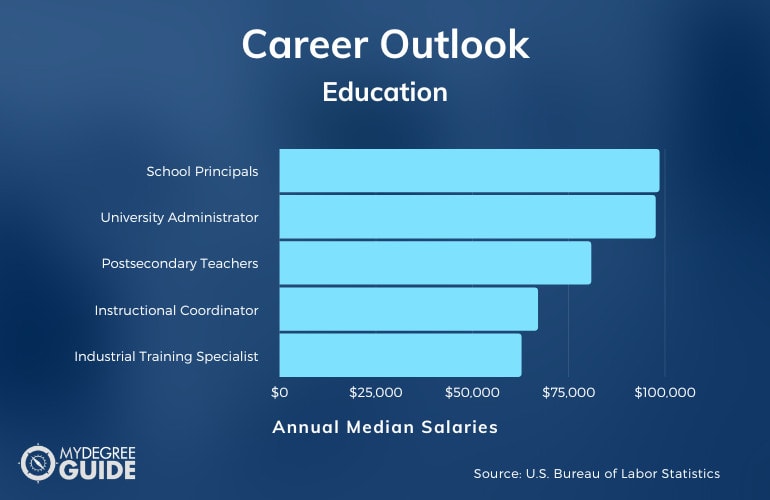
Earning a doctoral degree in education can open a number of career paths to you. Many of these options are in growing fields that offer promising salaries. For the next ten years, the Bureau of Labor Statistics predicts a job-growth rate of 5% for teachers, trainers and librarians. Some doctoral-level positions within the field of education are expected to experience a faster growth rate.
School Principals
Administrators, such as principals, may work at the elementary, middle school or high school levels.
Job Growth:
- Job Growth: 4%
Average Salary:
- Annual Median Salary: $98,490
Professors and Other Postsecondary Teachers
In a higher-education setting, you could train future teachers or work with adult learners.
Job Growth:
- Job Growth: 9%
Average Salary:
- Annual Median Salary: $80,790
Instructional Coordinator
The responsibilities of an instructional coordinator include overseeing curriculum and teaching methods.
Job Growth:
- Job Growth: 6%
Average Salary:
- Annual Median Salary: $66,970
Corporate or Industrial Training Specialist
As a training specialist, you can help employees improve their professional skills.
Job Growth:
- Job Growth: 9%
Average Salary:
- Annual Median Salary: $62,700
University Administrator
Student deans, academic deans, admissions directors and college presidents are part of a school’s administrative team.
Job Growth:
- Job Growth: 4%
Average Salary:
- Annual Median Salary: $97,500
Accreditation


Any college or university that you attend should be regionally accredited. This means that the entire school has received the approval of one of the main regional accreditors, such as the Higher Learning Commission or the Middle States Commission on Higher Education.
Your doctoral program may have additional accreditation from an industry-specific organization. The main accrediting body for schools of education is the Council for the Accreditation of Educator Preparation (CAEP). Early childhood programs may receive a distinction from the National Association for the Education of Young Children (NAEYC). Such accreditations affirm that a program is of the highest quality.
Financial Aid


The first step to obtaining financial aid for your doctoral program is to complete the free Application for Federal Student Aid (FAFSA). Once you’ve taken care of that, you may be able to qualify for financial aid in the form of:
- Grants
- Loans
- Scholarships
- Federal Work-Study
- Fellowships
Professional Organizations


Educators know how important it is to learn from one another, so there are many professional organizations available for people in this field. Becoming a member of one or more of these groups may offer you opportunities for networking, support, discounts and professional development.
Professional organizations include:
- American Association of School Administrators (AASA)
- American Association of University Administrators (AAUA)
- Association of American Educators (AAE)
- National Association for the Education of Young Children (NAEYC)
- National Association of Elementary School Principals (NAESP)
- National Association of Secondary School Principals (NASSP)
- National Education Association (NEA)
What is a Doctor of Education (Ed.D.)?
A Doctor of Education (Ed.D.) degree is a terminal degree designed for individuals who aspire to become leaders and experts in various fields related to education.
The primary purpose of an Ed.D. program is to enhance the skills and knowledge of scholars, teachers, university faculty, and other professionals with a focus on improving teaching practices, shaping educational policies, and promoting effective learning environments in workplaces.
The benefits of pursuing an Ed.D. include gaining practical knowledge that can be immediately applied to one’s job, such as implementing applied research methodologies and utilizing decision-making rubrics to address real-life problems. The degree program often offers specialized concentrations tailored to specific career paths. For instance, a teacher, principal, or dean might choose a concentration in Curriculum and Instruction, while an education administrator might opt for Educational Leadership. Additionally, professionals in fields like nursing, the military, or business may find value in concentrations such as Organizational Leadership.
Is It Possible to Get a Doctorate Degree Online?
Yes, many schools offer fully online doctoral programs; from beginning to end, you may never have to step foot on campus or meet face-to-face with your faculty advisors. Other schools have hybrid programs that can be completed mostly online but may require some on-campus classes or in-person residencies.
In fact, some universities now offer EdD programs without GRE requirements.
Are There Doctoral Programs in Education That Do Not Require a Dissertation?
In a doctoral program, it’s important for the faculty to assess how much you know about your chosen area of study. A dissertation is one means of conducting that evaluation, but it’s not the only way. Some doctoral programs do not require a dissertation, but instead rely on capstone projects or other assessments.
What is the Difference Between an EdD and a PhD in Education?
An EdD is a professional doctorate designed for real-world application. It’s most suitable for those who want to continue working in the field.
A PhD may deal more with educational theory and research. It may be suited for those who want to conduct original research or teach at the college level.
What is the Difference Between an EdD vs. EdS?
The main difference between an Ed.D. (Doctor of Education) program and an Ed.S. (Education Specialist) program lies in their academic focus, scope, and career outcomes. Both degrees are postgraduate programs in the field of education, but they serve different purposes and cater to distinct career goals.
Doctor of Education (Ed.D.)
An Ed.D. is a terminal degree, similar to a Ph.D., and is designed for individuals seeking leadership roles and expertise in educational research, policy-making, and administration. Ed.D. programs focus on advanced theoretical and practical knowledge, emphasizing leadership and innovation in educational settings. Graduates often pursue careers as school superintendents, education policymakers, or higher education administrators.
Education Specialist (Ed.S.)
On the other hand, an Ed.S. program is an intermediate, post-master’s level degree. It provides specialized training for educators looking to advance their careers in specific areas, such as school counseling, curriculum development, or educational technology. Ed.S. programs concentrate on practical skills and application, preparing graduates to become specialists in their chosen field, typically working as school counselors, instructional coordinators, or curriculum specialists.
An Ed.D. is a more research-oriented and leadership-focused degree, while an Ed.S. is a specialized program that enhances expertise in a specific educational area. The choice between the two depends on individual career aspirations, with the Ed.D. leading to higher-level leadership roles and the Ed.S. providing specialized expertise in a particular education-related field.
How Long Does It Take to Get a Doctorate in Education?
In general, a full-time education doctoral program may take three to four years to complete. A select few with accelerated tracks may be doable in just 18 to 24 months. Programs that require dissertations may take longer than non-dissertation doctorates.
Can I Work While Earning a Doctorate in Education?
Working full-time while going to school requires flexibility. Online doctoral programs can be ideal for those who need to balance school and employment. If you find that a full-time class load is too much, consider part-time enrollment.
What is the Biggest Difference Between a Traditional and an Online EdD Program?
Campus-based and online programs cover the same material and produce comparable results, but online EdD programs may offer greater scheduling flexibility. With >online classes, you may learn the material through a variety of media, including message boards, textbooks, interactive simulators, live discussions and prerecorded lectures.
How to Choose an Ed.D. Program
Choosing to pursue a Doctor of Education (Ed.D.) can seem like a daunting task, as the landscape of available programs can be vast and diverse. To aid aspiring doctoral candidates in making a well-informed decision, we’ve created a list of essential considerations for selecting an Ed.D. program.
- Program Delivery: Decide on your preferred mode of instruction, whether it’s a fully online, on-campus, or a blended Ed.D. program, depending on your personal preferences and logistical requirements.
- Program Duration: Evaluate whether the doctorate in education program offers part-time or full-time options that align with your current work commitments, ensuring it can be accommodated within your schedule.
- Areas of Specialization: Assess if the available Ed.D. concentrations align with your educational and career aspirations, as this will directly impact your expertise and future career prospects.
- Faculty Qualifications: Evaluate the expertise and engagement of Ed.D. professors within the education profession. Assess if their research interests align with your own and if their experience is relevant to your leadership objectives.
- Financial Considerations: Investigate the availability of internal funding opportunities, such as scholarships, to support your tuition costs. Additionally, consider the average loan burden of Ed.D. students and the potential for salary advancements after graduation.
- Required Coursework: Examine the relevance, currency, and applicability of the Ed.D. course content to your current or desired professional role, ensuring the program meets your specific career needs.
- Internship & Practical Experiences: Determine if you are interested in supervised leadership opportunities, as certain programs may include internships or fieldwork components to enhance practical skills.
- Dissertation or Culminating Project: Choose between a traditional dissertation or an alternative final project as the culmination of your doctoral studies, depending on your preferences and academic goals.
Keep in mind that the importance of each factor may vary based on individual values and priorities. Considering these key points will help you make an informed decision when selecting the most suitable Ed.D. program to meet your academic and career goals.