Looking for 2 year degrees? Find out what the top picks are and what jobs you can get with your associate’s degree.
Earning your associate degree in one of these fields can help you enter the workforce with in-demand skills or help set you up to finish a bachelor’s degree right away or some time in the future.
Editorial Listing ShortCode:
2 Year Degrees (Online & On Campus)
Click on field of study that most interests you to learn more about the degree program:
- Accounting
- Business Administration
- Child Development
- Computer Science
- Criminal Justice
- Special Education
- Engineering
- Entrepreneurship
- Fashion
- Fire Science
- Graphic Design
- Health Services
- Hospitality Management
- Human Services
- Information Technology
- Legal Studies
- Liberal Arts
- Marketing
- Medical Assisting
- Medical Coding
- Network Administration
- Paralegal
- Pharmacy
- Retail and Sales Management
- Small Business
Each of these degrees come as a two year, or associate degree, though the exact type will differ according to the field of study. Some are Associate of Arts degrees while others are Associate of Science or other types of two year degrees.
Accounting

Put your love for numbers and organization to work for you with a career in the accounting field. Accounting professionals may keep records of financial transactions, help people with their taxes, and perform clerical duties related to payroll.
In a two-year accounting program, you’ll begin to study cost accounting and managerial accounting. You’re sure to study topics like taxation and economics as well. The curriculum may include business classes on law, ethics, computer systems, and information technology.
Editorial Listing ShortCode:
Bookkeeping is an entry-level job to consider after completing this degree. On average, bookkeepers earn $41,230 each year. Another path to consider is being a payroll or timekeeping clerk, for which you might earn around $46,180 annually.
If you’d like to continue your studies with a bachelor’s program, consider an accounting or business major. Eventually, you may accumulate enough accounting-related college credits to become a certified public accountant.
Business Administration

Are you interested in working in an office or helping organizations reach their financial goals? If so, a degree in business might be for you.
A two-year business degree will introduce you to fundamental concepts that are applicable in many career paths. You’re likely to get an overview of accounting, business law, economics, business math, and finance.
Other topics may include human relations, management, marketing, and taxation. You may also learn to use software and communicate effectively through business writing or speaking.
Editorial Listing ShortCode:
Business is a broad field, so your post-graduation job options may be varied. One idea is to get started in an office setting as an administrative assistant or a clerk. On average, administrative assistants earn $39,850 annually.
A business degree may lead to several different four-year programs. A Bachelor of Business Arts is one option. Other majors to consider include accounting, finance, human resources, public relations, or marketing.
Child Development

If you enjoy working with young children, then you might make an excellent teacher. In this role, you may have the privilege of helping kids build a foundation for academic success as they get to know the world around them.
As an early childhood major, you’ll learn about working with babies, preschoolers, and kids who are just starting elementary school.
Early childhood students take classes in child development and psychology. You’ll also need to learn how to organize a classroom, manage behavior, and deliver effective instruction. Lessons on classroom observation can help prepare you to learn from experienced teachers.
Editorial Listing ShortCode:
With this degree, you may become a preschool teacher or a daycare worker. On average, preschool teachers make $30,520 annually, and childcare workers earn $24,230.
After completing this program, you may want to get a bachelor’s degree, so you may pursue licensure. Majors to consider include early childhood or elementary education.
Computer Science

Become more tech-savvy and help businesses achieve their networking goals by earning a degree in computer science. Jobs in computers and information technology are growing at a rate of 11%, so you may expect the skills you learn to be in demand by employers.
The curriculum will cover computer architecture, networks, and databases. You’ll study the fundamentals of programming languages and may learn to use one or more of them. The choices may include C++, Java, and HTML.
Since this is a scientific program, you can expect to take several math classes and a technical writing course.
Editorial Listing ShortCode:
Being a web developer is one example of a job that you may pursue with an associate’s in computer science. The average salary for this job is $73,760.
If you choose to continue your education instead of pursuing an entry-level position, consider transferring your associate’s degree into a computer science bachelor’s program.
Criminal Justice

Are your sights set on being a police officer or playing a role in the legal field? A two-year criminal justice degree can help you get there.
This program will cover topics like criminal law, policing, criminology, and forensic psychology. You’ll discuss corrections and remediation for juvenile offenders and talk about how to carry out criminal justice processes in diverse or global settings.
The classes will also help you develop an ethical framework for your criminal justice practices.
Editorial Listing ShortCode:
You may be able to apply for a job with a police force after finishing this program; patrol officers can earn around $63,150 each year. If you choose to go into corrections, your annual salary might be around $45,180 annually. As a security guard, you could earn $29,680 each year.
For a bachelor’s degree program, consider extending your criminal justice studies or pursuing a homeland security or corrections major.
Special Education

Put your care and concern for children into practice in a special education associate’s degree program. You’ll start learning how to work with kids who need extra attention or personalized accommodations in the classroom.
Your curriculum will include general education classes that cover topics like child development, learning theories, classroom observation, and teaching strategies. You may also gain skills specifically for working with students who have special needs.
The classes may provide an overview of disabilities and exceptionalities, and they may also cover early intervention and other educational strategies that can support students who have special needs.
Editorial Listing ShortCode:
Earning this degree may be useful for classroom aides and childcare workers. As a teacher assistant, you might earn around $27,920 each year.
Transferring to a bachelor’s degree after graduation can help prepare you for teacher licensure in your state. You may pursue a special education, early childhood, elementary, or secondary teaching degree.
Engineering


If you’re a student who’s strong in math and science, you may be successful in an engineering program. Your courses may prepare you to work in industrial, electrical, or mechanical engineering or one of the many other engineering domains.
To earn your degree, you’ll need to take multiple math and science classes, such as calculus, differential equations, chemistry, and physics. You’ll also study engineering skills like computer modeling, circuit design, computer programming, electrical systems, and construction materials.
Some of these may be offered as electives so you can pick the courses that are most applicable to your future career goals.
Editorial Listing ShortCode:
Engineering technicians may be successful with just a two-year degree. One of the top-paying technician disciplines, aerospace engineering and operations, pays an average salary of $66,020.
A two-year engineering degree may be good preparation for a bachelor’s degree program in engineering or another science-based discipline.
Entrepreneurship


Starting your own business can be exciting but risky. Increase your chances of success with college courses designed to prepare you for the ups and downs of small business leadership.
In an entrepreneurship two-year degree program, you’ll study business basics, such as office technology, accounting, human resources, management, and business law.
You may learn to be creative and effective with your marketing through channels like social media and sales teams. Other courses may teach you about getting an idea off the ground and bringing a project to completion.
Editorial Listing ShortCode:
You may use these skills to launch your own business after graduation. Your skills may also be applicable in many business settings. For example, as an advertising sales agent, you might earn around $53,310 each year.
The courses you take for this associate’s degree may transfer into a variety of bachelor’s programs. These may include entrepreneurship, business, marketing, organizational leadership, finance, or management.
Fashion


Are you crazy about clothes and passionate about helping people look their best? When you pursue a fashion degree, you may boost others’ confidence by outfitting them with great clothing.
For this program, you’ll take classes in color theory and design fundamentals. Additionally, you may learn to use materials and assemble pieces, and you may practice using digital tools to experiment with designs.
Retail management and selling may be other topics that your studies will cover. Your degree program may focus on a specific aspect of this discipline, such as merchandising or design.
Editorial Listing ShortCode:
You may get an entry-level job with a fashion design firm or go into retail and merchandising. Retail sales managers may earn about $40,350 annually. Another idea is to become a buyer who decides which items a store should carry.
Consider extending your studies with a bachelor’s degree program in fashion design, fashion business, or textiles and fabric.
Fire Science


If rescuing people is what you feel you were born to do, then getting your associate’s program in fire science may be the training that you need. Having this degree may give you an advantage over other candidates when applying for in-demand firefighting jobs.
Your studies will include courses on the way that fire behaves. That includes how combustion happens and how a fire spreads. You’ll also study strategies for preventing blazes, techniques for putting them out, and strategies for being prepared for a disaster.
You may also study how to inspect and analyze the debris that’s left behind after a fire.
Editorial Listing ShortCode:
After graduation, you may look for work with a fire services agency. This might be in a community setting or with a forestry organization. Fire inspectors earn about $60,230 each year, and firefighters make $50,850.
For a bachelor’s degree, consider fire science, fire management, or another emergency-services program.
Graphic Design

If you have a creative spirit and an eye for layouts, then you may channel that artistic ability into a graphic design career. Others may count on you to make their publications and advertisements pop.
You might gain a better appreciation for art history and the works of the masters. As you study others’ creations, you’ll also review the fundamentals of eye-pleasing designs. Your courses may introduce you to software used for creating layouts and editing images.
In addition to creating still images, you may also learn about animation. During your studies, you may begin building a portfolio of your work to show potential employers.
Editorial Listing ShortCode:
Graphic designers make an average of $52,110 annually, but a bachelor’s degree is required for most positions. With your associate’s degree, you may be able to work as a design assistant.
For a related four-year degree, consider visual art, graphic design, or interaction design.
Health Services

You can help healthcare organizations achieve their missions by working in an office or administrative role. A degree in health services may introduce you to the skills and tools needed for this job.
To get started, you’ll need to learn healthcare fundamentals like privacy laws, human anatomy, and medical terminology. Other classes can help you learn about the systems that are used for healthcare delivery and reimbursement in the U.S.
You’ll study administrative procedures, medical records programs, and management skills. Plus, you may also learn how to interact with patients in professional and ethical ways.
Editorial Listing ShortCode:
With an associate’s degree, you might be able to work as a medical records technician. The median pay for that role is $42,630 per year.
Earning a bachelor’s degree may qualify you to take a position as a health services manager. Consider a four-year degree in health services, healthcare administration, or business.
Hospitality Management


Pursuing a career in the hospitality industry means that you will spend your career creating a welcoming environment for others. Whether you want to work in restaurants, hotels, tourism agencies, resorts, casinos, or event venues, a degree in hospitality management can help you get there.
The curriculum will cover business principles, management, and marketing. You may learn to use spreadsheets and other office software that can streamline your operations.
If you’re interested in a particular area of hospitality, you may be able to take electives like Hotel Management, Conference Hosting, and Restaurant Operations. Whatever your area of focus, you may learn about delivering high-quality customer services.
Editorial Listing ShortCode:
This degree presents diverse career options. For example, you may be a concierge, earning about $31,390 each year. Alternatively, as a restaurant manager, you might make $55,320 annually.
For a related bachelor’s program, you could consider studying tourism, restaurant management, or hospitality.
Human Services

If you care deeply about others and want to help them improve their lives, you might make a good caseworker or program manager. With a career in human services, you may help people get through hard times and connect with community resources.
Human services associate’s degree programs can help equip you with skills for working with people. Having a better understanding of psychology and sociology can help you with that. You’ll explore addiction and other struggles, such as addiction, that can make daily activities challenging.
Your classes may teach you to conduct assessments and design beneficial interventions or programs that can help people in need.
Editorial Listing ShortCode:
Human services assistants earn a median salary of $35,060 each year. This job category includes titles like caseworker aide and social work assistant. You might work with people who are facing addiction, homelessness, post-traumatic stress disorder, or disabilities.
Bachelor’s programs to consider include human services, social work, and psychology.
Information Technology

Organizations rely on digital systems to store and transmit information. A degree in information technology can help prepare you to carry out the essential work of designing, maintaining, and troubleshooting these systems.
After taking introductory classes that cover IT fundamentals, you’ll dig into concepts like network design, cybersecurity, and programming languages. The courses may teach you to use modern office applications, head up projects, and develop software programs.
You may have the opportunity to complete an internship in the IT department of an organization.
Editorial Listing ShortCode:
Web development is a popular career path after graduating with an IT associate’s degree. You may also work as a computer support specialist who helps others use technology and fixes their computer problems. The average pay for this job is $54,760 per year.
To further your IT education, consider transferring your credits into a bachelor’s program related to computer science, network administration, or information technology.
Legal Studies


Although becoming a lawyer takes years of study, you may enter the legal field with just a two-year degree. After an associate’s program in legal studies, you may become an integral part of a legal team.
The classes for this degree program may include Introduction to Legal Studies, Writing for Legal Settings, and Legal Research Strategies. You may also study criminal and civil law, software for legal settings, ethics, torts, and software programs.
Editorial Listing ShortCode:
The most common jobs for people with this degree are paralegal and legal assistant. The average salary for those positions is $51,740 per year. You might also use your legal knowledge to become a legal secretary, making $47,300, or a title examiner, earning about $48,180.
In a four-year degree program, you may continue your pursuit of a legal studies degree. You may also be able to transfer your credits into a pre-law or political science program.
Liberal Arts

For a generalist associate’s program, look into studying liberal arts. This degree may be a great choice for students who know they want to earn a college degree but don’t have their sights set on a particular major. It’s also a versatile transfer degree.
In a liberal arts program, you’ll take a variety of foundational classes. These are likely to include studies in literature, science, history, composition, and philosophy. You may get to round out your degree program with multiple electives of your choosing.
Editorial Listing ShortCode:
A degree in liberal arts doesn’t prepare you for any one particular career. Even still, you may be able to land a higher-paying job once you’ve graduated. On average, people with associate’s degrees earn 18% to 26% more than those without a degree.
Because of the general nature of this degree, it may be easy to transfer into a variety of Bachelor of Arts programs.
Marketing

If you have the power of persuasion, then you may put those skills to work for you in a marketing career. Marketing may also be a great choice if you’re interested in consumer behavior or product trends.
A marketing program may offer classes like Marketing Fundamentals, Marketing Communications, and Global Business. You may learn about using social media for marketing purposes, conducting market research, and thinking creatively.
The courses will give an overview of the various domains of marketing, including advertising and public relations.
Editorial Listing ShortCode:
With a two-year degree, you may take an assistant or junior marketing position. Other career options include retail sales manager or social media specialist. As a wholesale sales representative, you might earn about $63,000 annually.
The classes you take may someday help you earn a bachelor’s degree in marketing. Your credits may also be useful in a related program like business administration or public relations.
Medical Assisting

Medical assistants take care of important responsibilities in a healthcare setting. Choosing this career path may allow you to support doctors and nurses in their work and make a difference for patients.
To get started with a job in medical assisting, you’ll need to learn about human anatomy, medical terminology, and basic procedures. The courses can help you learn about the software and systems that may be used in the office of your facility.
You’ll also explore the reimbursement structures used in U.S. healthcare and become familiar with medical coding. You’ll probably need to gain hands-on clinical experience.
Editorial Listing ShortCode:
As a medical assistant, you might work in the office of a healthcare facility, or you may perform clinical services for patients. Medical assistants earn an average annual salary of $34,800.
Later, your associate’s studies and your professional experience may help you succeed in a bachelor’s program in healthcare management or nursing.
Medical Coding

Healthcare billing and coding can be complicated, but you might be an expert who’s up to the task after earning a degree in medical coding. Gaining this knowledge can help make you a valuable member of a healthcare administration team.
Your classes may include Introduction to Coding, Human Anatomy and Physiology, and Health Records Systems. You may gain in-depth practice with coding systems and styles, and you may complete practicum experiences in which you can exercise your skills.
Other courses will cover patient privacy laws, insurance structures, and healthcare databases.
Editorial Listing ShortCode:
With this degree and the proper certification, you may pursue work as a medical records or health information technician. The median annual pay for that job category is $42,630.
To continue your studies, consider transferring to a four-year program in health informatics, healthcare management, or healthcare administration. These programs can help prepare you to take supervisory roles in a medical office.
Network Administration

Without strong networks, an organization’s productivity may be affected. You may study network administration so you may be prepared to maintain the software and hardware that keep networks running smoothly.
Network professionals work with operating systems regularly, so you may learn about Windows and Linux. You may also become more knowledgeable of network architecture, routing, and switching.
Learning how computers process information can help equip you to communicate with digital systems and build software programs.
Editorial Listing ShortCode:
Although some companies require a bachelor’s degree for their network professionals, other organizations may consider your associate’s degree sufficient for a position as a network or computer systems administrator.
The average pay for that job is $83,510 per year. Alternatively, you may enter this field as a network support specialist.
After finishing your associate’s degree, you may want to return to school for a bachelor’s degree in computer science, information technology, or computer forensics.
Paralegal

Some students know they want to be involved with the legal field, but they may not be sure exactly what role they want to play. Those students may opt for an open-ended legal studies degree.
Others, knowing specifically that a paralegal career is for them, may consider a paralegal degree program to be the better choice.
If you choose to get a paralegal associate’s degree, you’ll take classes in paralegalism and legal research. The courses will give you an overview of disciplines like criminal law and family law. You may also study what it takes to provide leadership among legal support professionals.
Editorial Listing ShortCode:
As a paralegal, you may earn about $51,740 annually. You may work in a law office, a corporation, or a government agency.
To continue your paralegal career, you may not need additional schooling. To shift into a slightly different role, you may get a bachelor’s degree in legal studies.
Pharmacy

Technicians may carry out many tasks in a pharmacy setting. To learn how to work with medications, and interact with customers, consider going to school for a pharmacy technician associate’s degree.
The studies for this program will include an overview of healthcare, patient care, and illnesses. You may learn about medications that are used to treat diseases and how to calculate their dosages. Plus, you’ll talk about pharmacy ethics and discover how to maintain patient privacy.
Editorial Listing ShortCode:
After graduation, you may be ready for your certification as a pharmacy tech. In that job, you may earn around $33,950 each year. Job openings are increasing at a rate of about 4%.
This may be a terminal degree that helps prepare you for a long-term career as a pharmacy technician. If you choose to switch tracks, your studies and experience may give you a good foundation for applying to pharmacy school to become a licensed pharmacist.
Retail and Sales Management

Succeeding in a store environment or leading a team of sales representatives takes knowledge and skill. You may develop those strengths in an associate’s program dedicated to retail and sales management. If you thrive on the high energy of a sales environment, then this might be the career path for you.
You will take classes that help you become a better salesperson, a competent businessperson, and a strong leader. These courses may cover topics like communication, management, and interpersonal relations.
Studying marketing and consumer behaviors can help you refine your ability to sell products or services to others. Taking accounting classes can help prepare you to keep your store’s books in order.
Editorial Listing ShortCode:
You may work in a retail or other sales environment after graduation. Sales managers in some settings can earn $126,640 or more each year.
To build on your studies with a bachelor’s program, consider management, business, hospitality, or sales.
Small Business

Do you have dreams of owning your own business and being your own boss? Running a small business may be challenging, but getting a college education can help spur you on toward success.
This type of associate’s program will include courses in accounting, business culture, and communications. A course in merchandising can help you learn about pricing your goods and promoting them.
You may develop your skills in working with employees and other business leaders, and you may learn to conduct supply chain negotiations. Hopefully, by the end of the program, you may have developed the confidence to launch a business and grow it over time.
Editorial Listing ShortCode:
Small business owners are self-employed, and salaries can vary widely. Some business owners pay themselves a minimal salary for several years while getting their organizations off the ground.
For future education, you could consider a bachelor’s degree in business administration, retail management, or entrepreneurship.
Career Outlook for 2 Year Degree Jobs in Demand

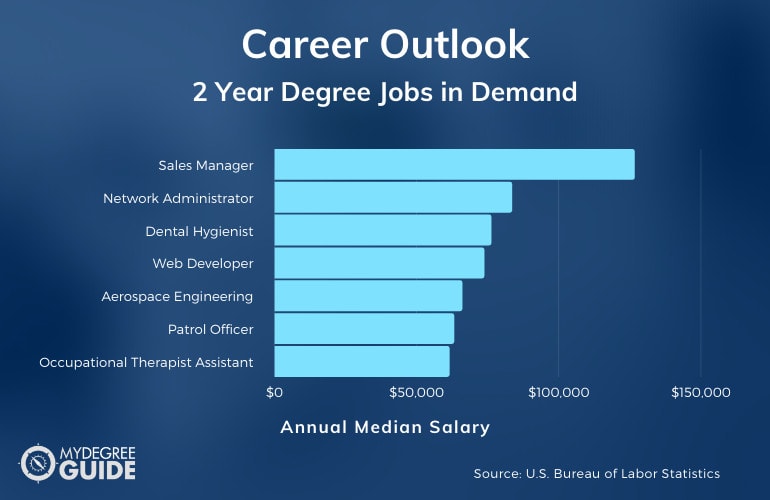
A two-year degree doesn’t need to limit your job opportunities. There are a number of high-paying, in-demand careers for which you need only an associate’s degree.
According to the Bureau of Labor Statistics, some of these careers include:
| Career | Annual Median Salary |
| Sales Manager | $126,640 |
| Network Administrator | $83,510 |
| Dental Hygienist | $76,220 |
| Web Developer | $73,760 |
| Aerospace Engineering and Operations Technician | $66,020 |
| Patrol Officer | $63,150 |
| Occupational Therapist Assistant | $61,510 |
| Respiratory Therapist | $61,330 |
| Fire Inspector | $60,230 |
| Physical Therapist Assistant | $58,790 |
| Restaurant Manager | $55,320 |
| Paralegal | $51,740 |
| Firefighter | $50,850 |
| Health Information Technician | $42,630 |
Besides your education, your earnings will also depend on your level of experience, industry, and location.
Accreditation for 2 Year Degrees


There are many 2 year degree jobs in demand — but only for those whose degree comes from a reputable college.
The way to know whether a school is good is to make sure that it holds regional accreditation. This means that the college has been approved by an official accrediting body.
There are seven regional accrediting organizations:
- Accrediting Commission for Community and Junior Colleges (ACCJC) Western Association of Schools and Colleges
- Higher Learning Commission (HLC)
- Middle States Commission on Higher Education (MSCHE)
- New England Commission of Higher Education (NECHE)
- Northwest Commission on Colleges and Universities (NWCCU)
- Southern Association of Colleges and Schools Commission on Colleges (SACSCOC)
- WASC Senior College and University Commission (WSCUC)
Choosing an accredited program is especially important if you want the option to transfer your credits into a bachelor’s degree program.
Financial Aid for an Associates Degree


Earning 2 year degrees online may be an excellent way to jumpstart your career without shelling out big bucks for tuition at a four-year college. Even still, an associate’s degree costs money, and you may need help affording it.
Government assistance can be quite valuable. State governments and the federal government have programs for distributing funds to students in need. Grants don’t need to be repaid, but loans do.
Government loans usually carry low-interest rates, which can make them more affordable than private loans. Filling out the Free Application for Federal Student Aid (FAFSA) should be your first step in securing government assistance.
You can also apply for scholarships. This gift money may come from your school or an outside source. You may qualify based on your merits — such as getting good grades, showing leadership qualities, or being a star athlete — or your financial need.
Scholarship applications may require you to submit an essay about your career goals or your positive qualities.
If you need guidance about applying for assistance, talk to your school’s financial aid department. They may be able to recommend scholarship opportunities or suggest a payment plan for your tuition.
What Is the 2 Year Degree Name?


If you’re wondering, “2 years of college is what degree?” then you’re not alone. Many people are curious about the 2 year degree name. This is typically called an associate’s degree.
You may earn your associate’s degree from a college that offers both two- and four-year programs, or you may earn it from a community college or trade school that specializes in two-year offerings.
What Degree is 2 Years of College?
If you’re enrolled in an associate’s degree program, you may earn a degree in approximately two years. The course of study is typically equivalent to the first two years of a bachelor’s program.
For that reason, when transferring your completed associate’s credits into a four-year college, you may be able to start as a junior and be finished after just two more years.
Is There a 2 Year Engineering Degree?
Yes, there is a 2 year engineering degree. With just two years of college, you may get started with your engineering career. Options include an Associate of Science in Engineering, an Associate in Engineering Science, and an Associate of Science in Engineering Technology.
These degrees may prepare you to earn an engineering bachelor’s degree or to work as an engineering technician. As a technician, your area of specialty might be aerospace operations, electronics, industrial engineering, or another branch of this field.
Can You Have Two Associates Degrees?
Yes, you can earn multiple associate’s degrees. In fact, some students enroll in both Associate of Arts (AA) and Associate of Science (AS) programs so that they may broaden their general knowledge base and learn more about their chosen field.
Having a few associate’s degrees may increase the chances of getting into a particular bachelor’s program or increase your appeal to potential employers.
What Are the Best Two Year Degrees?

According to the Bureau of Labor Statistics, a number of associate’s degrees can help you launch a career that brings in a reliable income.
The degree for you may depend on what you’d like to do after graduation. Choosing a discipline that allows you to draw on your strengths can help you go far in life.
After exploring the above suggestions for two-year degrees, you might decide that studying engineering, health services, industrial technology, legal studies, or hospitality management is the right course of action for you.
Next up, submit applications to two-year schools, and get ready to become a college student!